
This page outlines the procedures that must be completed when leaving Kyoto University due to graduation, withdrawal, or other reasons.
International students should make sure to review the section that applies to their post-departure plans below.
- For those leaving Japan
- For those remaining in Japan (such as for enrollment in another university in Japan, employment, or job hunting)
For those leaving Japan
- Procedures related to various contracts
- Procedures at the city or ward office
- Procedures at Kyoto University
- Procedures related to status of residence
- Other
- Procedures at the airport
- Additional information
Check list (for those leaving Japan)
画像
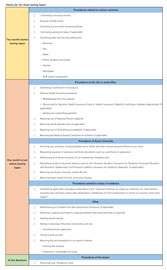
Check list (for those leaving Japan)
Procedures related to various contracts
Terminating a housing contract
Review your lease agreement and notify your landlord or real estate agent of your planned move-out date within the required notice period. In most cases, you must give notice one to two months before the month in which you intend to move out. If you fail to notify them by the deadline specified in the contract, you may be charged rent for the following month.
Before moving out, make sure to clean the property thoroughly and return it to its original condition, or else repair and cleaning costs may be deducted from your security deposit (shiki-kin). In cases of significant damage or poor condition, you may be required to pay additional charges.
For more details, refer to the Housing Guidebook, issued by the Kyoto University International Service Office.
Disposal of bulky waste
To dispose of bulky items such as furniture, bedding, or bicycles, please follow the rules set by your local municipality. This may require contacting the relevant city or ward office, or a branch office.
Please note that, under Japanese law, televisions, air conditioners, refrigerators/freezers, washing machines, and personal computers cannot be collected by municipalities. For these items, you must arrange collection through the electronics store where you purchased them, an authorized collection service, or the manufacturer. A collection fee will be charged in all cases.
- Kyoto City Oversized Refuse Collection Center (Ogata Gomi Uketsuke Center)
Phone (in Japanese): 0120-000-530 (toll-free; not available from mobile phones) or 0570-000-247 (for calls from mobile phones; charges apply) - Garbage separation and recycling guide
- Uji City Hall (Machi Bika Suishin-ka [urban beautification promotion division]) Oversized Refuse Collection (in Japanese)
Phone: 0774-22-3141
Cancelling utility services and settling bills
Please remember to contact the relevant utility providers at least one week prior to moving out to settle your electricity, gas, water, telephone, and other utility bills.
Procedures at the city or ward office
International students who will be leaving Japan after completing their studies are required to visit the city or ward office (or a branch office) in the area where they reside and complete the following procedures once their departure date has been decided.
Required items
- Passport
- Residence Card
- National Health Insurance Card or Health Insurance Eligibility Certificate (shikaku kakuninsho)
- Basic Pension Number Notice or National Pension Handbook (if enrolled in the National Pension Scheme)
- My Number Card (if applicable)
Submitting a notification of moving out
Submit a Notification of Moving Out to the resident registration counter within four weeks prior to your planned departure date. This procedure must be completed before applying to withdraw from the National Health Insurance and the National Pension System (see below).
Withdrawing from the National Health Insurance
National Health Insurance (NHI) premiums are calculated on a monthly basis and are generally paid in ten installments per year. International students leaving Japan must settle any overpaid or underpaid premiums at the NHI counter of their city or ward office. The expiration date on the NHI card will be adjusted to remain valid until the date of departure, allowing it to be used up to that day.
Reporting loss of National Pension eligibility
Contact the National Pension System (NPS) section of your city or ward office to report the loss of eligibility. If you meet certain conditions, such as having paid pension premiums for six months or longer, you may apply for a lump-sum withdrawal payment, under which part of the premiums paid will be refunded.
For details on the lump-sum withdrawal payment system, please visit the link below or contact the NPS section of your municipal office.
Lump-sum Withdrawal Payments|Japan Pension Service
Returning your My Number Card (if applicable)
Return your My Number Card to your city or ward office. If you may return to Japan in the future, however, you must have your card processed for expatriation (deactivation). You will then receive your My Number Card back, which you are expected to keep in a safe place until the next time you come to Japan and register as a resident. The 12-digit number assigned to you will remain unchanged even after you leave the country.
Procedures at Kyoto University
Withdrawing from Kyoto University Co-op membership (members only)
Your full capital contribution (4,000 yen for international students) will be refunded. Details on the withdrawal procedure are available on the following page:
Procedures related to status of residence
When international students with the “Student” status of residence leave the University due to graduation, completion of studies, withdrawal, or other reasons, they are no longer permitted to stay in Japan under this status, even if their period of stay has not expired. They must either leave Japan immediately or, if they wish to continue residing in Japan, apply for a change of status of residence. Remaining in Japan without taking the appropriate procedures constitutes a violation of the Immigration Control and Refugee Recognition Act and may result in the revocation of one’s status of residence.
Other
Closing a bank account
Please request account closure at the counter of your bank or post office. If you pay utility bills through automatic bank transfers, be sure to confirm that all outstanding payments have been settled before closing your account. Transferring, selling, or otherwise providing your bank account to another person -- including your bankbook and cash card -- is a criminal offence. This must never be done.
Required items
- Residence Card with your address printed on the reverse side
- Passbook (if applicable) and cash card
- Passport
- Personal seal (inkan, if used when opening the account)
Open hours
- Banks: Mon–Fri 9:00–15:00 (except on holidays)
- Post Office: Mon–Fri 9:00–16:00 (except on holidays)
Refer to CLOSURE OF ACCOUNTS on the following page:
General information for daily life and support for foreign nationals | Kyoto University International Service Office
Procedures at the airport
Returning your Residence Card
Return your Resident Card to the customs officer at the port of departure (eg, Kansai International Airport).
Additional information
Joining Kyoto University Alumni
You can join an alumni association in your home country even while you are still enrolled at Kyoto University. Being a member allows you to seek advice easily from senior alumni on student life, career paths, and other matters. After returning home, you can stay connected with fellow graduates and with the University through local activities and events.
A list of regional alumni associations is available via the link below. If you wish to join, please contact the relevant association directly using the contact information provided.
Authentication of official seals by the Ministry of Foreign Affairs of Japan
Important: Degree certificates and related documents issued since April 2004 are no longer eligible for Apostille certification.
Authentication of official seals (koin kakunin) is a certification issued by the Ministry of Foreign Affairs of Japan (MOFA) to confirm that public documents issued in Japan are valid and can be recognized as such overseas. Applications may be submitted only when authentication is required by the receiving institution abroad or by a foreign embassy or (general) consulate in Japan.
After obtaining official authentication from MOFA, you must also obtain consular legalization from the embassy or (general) consulate of the destination country in Japan.
Please note that this process can be time-consuming. In addition, diplomas and graduation and degree certificates are issued only after the graduation or degree conferment ceremony, meaning that the authentication process cannot begin until then. You are therefore strongly advised to confirm the required procedures and the expected processing time in advance with the receiving institution or the relevant foreign embassy or consulate in Japan.
What is an Authentication (of official seals) / Apostille? | Ministry of Foreign Affairs of Japan
For those remaining in Japan (such as for enrollment in another university in Japan, employment, or job hunting)
- Procedures related to various contracts (for those relocating)
- Procedures at Kyoto University
- Procedures at the city or ward office (for those relocating)
- Procedures related to status of residence
- Other (for those applicable)
- Additional information
Check list (for those remaining in Japan)
画像
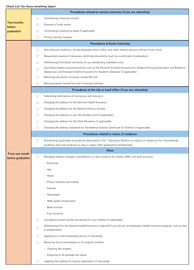
Check list (for those remaining in Japan)
Procedures related to various contracts (for those relocating)
Terminating a housing contract
Review your lease agreement and notify your landlord or real estate agent of your planned move-out date within the required notice period. In most cases, you must give notice one to two months before the month in which you intend to move out. If you fail to notify them by the deadline specified in the contract, you may be charged rent for the following month.
Before moving out, make sure to clean the property thoroughly and return it to its original condition, or else repair and cleaning costs may be deducted from your security deposit (shiki-kin). In cases of significant damage or poor condition, you may be required to pay additional charges.
For more details, refer to the Housing Guidebook, issued by the Kyoto University International Service Office.
Disposal of bulky waste
To dispose of bulky items such as furniture, bedding, or bicycles, please follow the rules set by your local municipality. This may require contacting the relevant city or ward office, or a branch office.
Please note that, under Japanese law, televisions, air conditioners, refrigerators/freezers, washing machines, and personal computers cannot be collected by municipalities. For these items, you must arrange collection through the electronics store where you purchased them, an authorized collection service, or the manufacturer. A collection fee will be charged in all cases.
- Kyoto City Oversized Refuse Collection Center (Ogata Gomi Uketsuke Center)
Phone (in Japanese): 0120-000-530 (toll-free; not available from mobile phones) or 0570-000-247 (for calls from mobile phones; charges apply) - Garbage separation and recycling guide
- Uji City Hall (Machi Bika Suishin-ka [urban beautification promotion division]) Oversized Refuse Collection (in Japanese)
Phone: 0774-22-3141
Changing the address or canceling and setting up utility services
Contact the relevant utility providers to update your address or to cancel your current services and arrange new contracts at your new residence.
Procedures at Kyoto University
Withdrawing from Kyoto University Co-op membership (members only)
Your full capital contribution (4,000 yen for international students) will be refunded. Details on the withdrawal procedure are available on the following page:
Kyoto University Co-op
Procedures at the city or ward office (for those relocating)
International students relocating within Japan are required to complete the procedures outlined below at their city or ward office.
Required items
- Passport
- Residence Card
- National Health Insurance Card or Health Insurance Eligibility Certificate (shikaku kakuninsho)
- Basic Pension Number Notice or National Pension Handbook (if enrolled in the National Pension Scheme)
- My Number Card (if applicable)
Submitting a notification of moving out and moving in
If you move out of Kyoto City, you must submit a notification of moving out at the resident registration counter of your ward office. After relocating and within 14 days of the move, you are required to complete moving-in registration at the city or ward office (or branch office) of your new place of residence.
Please consult the relevant city or ward office staff for more details.
Changing the address for the National Health Insurance
Complete either of the following procedures at the National Health Insurance (NHI) counter of your city or ward office.
- If you have moved within the same municipality: Submit a notification of address change.
- If you have moved to a different municipality: Complete the loss of eligibility procedure at the city or ward office of your former residence, then re-enroll in National Health Insurance at the city or ward office of your new place of residence.
Note: If you enroll in an employer-sponsored health insurance plan due to employment or other reasons, please complete the procedure to withdraw from National Health Insurance.
Changing the address for the National Pension System
Complete the address change procedure at the National Pension System (NPS) counter of the city or ward office responsible for your new place of residence.
Note: If you enroll in the Employees’ Pension Insurance or another pension scheme due to employment or other reasons, you will be automatically transferred from the National Pension System. In such cases, no withdrawal procedure from the National Pension System is required.
Changing the address on your My Number Card (if applicable)
Complete the address change procedure at the resident registration counter of the city or ward office responsible for your new place of residence.
Procedures related to status of residence
When international students with the “Student” status of residence leave the University due to graduation, completion of studies, withdrawal, or other reasons, they are no longer permitted to stay in Japan under this status, even if their period of stay has not expired. They must either leave Japan immediately or, if they wish to continue residing in Japan, apply for a change of status of residence. Remaining in Japan without taking the appropriate procedures constitutes a violation of the Immigration Control and Refugee Recognition Act and may result in the revocation of one’s status of residence.
Other
Applying for a mail-forwarding service (if relocating)
When you move to a new address, please submit a change-of-address notification to your local Japan Post office. For one year from the date of submission, mail and other items sent to your former address will be forwarded to your new address free of charge.
See the following for details:
Practical Guide for International Students - Japan Post
Additional information
Joining Kyoto University Alumni
You can join an alumni association in your home country even while you are still enrolled at Kyoto University. Being a member allows you to seek advice easily from senior alumni on student life, career paths, and other matters. After returning home, you can stay connected with fellow graduates and with the University through local activities and events.
A list of regional alumni associations is available via the link below. If you wish to join, please contact the relevant association directly using the contact information provided.
Authentication of official seals by the Ministry of Foreign Affairs of Japan
Important: Degree certificates and related documents issued since April 2004 are no longer eligible for Apostille certification.
Authentication of official seals (koin kakunin) is a certification issued by the Ministry of Foreign Affairs of Japan (MOFA) to confirm that public documents issued in Japan are valid and can be recognized as such overseas. Applications may be submitted only when authentication is required by the receiving institution abroad or by a foreign embassy or (general) consulate in Japan.
After obtaining official authentication from MOFA, you must also obtain consular legalization from the embassy or (general) consulate of the destination country in Japan.
Please note that this process can be time-consuming. In addition, diplomas and graduation and degree certificates are issued only after the graduation or degree conferment ceremony, meaning that the authentication process cannot begin until then. You are therefore strongly advised to confirm the required procedures and the expected processing time in advance with the receiving institution or the relevant foreign embassy or consulate in Japan.
What is an Authentication (of official seals) / Apostille? | Ministry of Foreign Affairs of Japan