

Kyoto, Japan -- Pulmonary arterial hypertension, or PAH, is a rare and severe disease characterized by elevated blood pressure in the pulmonary arteries, which transport blood from the heart to the lungs. This can eventually lead to right heart failure, when the heart's right ventricle becomes too weak to pump sufficient blood through the lungs and to the rest of the body.
Current treatments for PAH have improved the outcome for patients, but the prognosis for this disease is still poor and some patients end up needing lung transplants. C-type natriuretic peptide, or CNP, is a hormone involved in the regulation of vascular function, and a team of researchers at Kyoto University and collaborating institutions wondered whether it might also have therapeutic potential in PAH.
"CNP has been studied mainly in cardiovascular biology, but we wondered whether it might also play an important protective role in pulmonary vascular disease," says first author Hiromu Yanagisawa. The role of this hormone and its receptor GC-B in the pulmonary vasculature and the development of PAH has remained unclear, so the team was motivated to investigate.
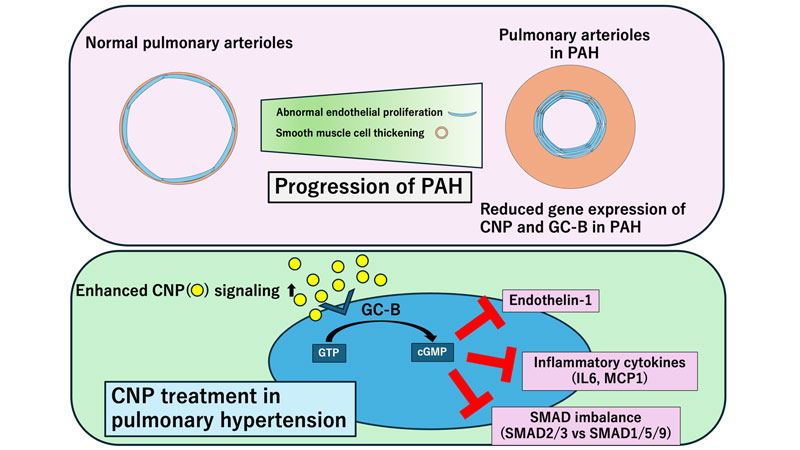
Using mouse models of pulmonary hypertension, the researchers examined the effects of disrupting the CNP/GC-B pathway specifically in endothelial cells and vascular smooth muscle cells. They also tested the effects of CNP administration in experimental pulmonary hypertension and analyzed publicly available single-cell RNA-sequencing datasets from patients with PAH.
The researchers found that the expression of both CNP and GC-B was consistently reduced across the experimental models and RNA-sequencing datasets, showing that CNP/GC-B signaling is downregulated in pulmonary hypertension. They also found that pulmonary hypertension became more severe in endothelial cell-specific knockout mice, but not in vascular smooth muscle cell-specific knockout mice, demonstrating that the protective effect depends specifically on endothelial CNP/GC-B signaling.
These results reveal that in endothelial CNP/GC-B signaling plays a protective role against pulmonary arterial hypertension, and that administration of CNP ameliorates experimental pulmonary hypertension through endothelial GC-B.
The findings provide new insight into the mechanisms underlying the development and progression of PAH, and suggest that targeting the CNP/GC-B signaling pathway may represent a promising approach for the development of new therapies for this severe disease.
"This study builds on many years of research in our laboratory, so it was especially meaningful for us to uncover a new protective role for endothelial CNP/GC-B signaling in PAH," says first author Hiromu Yanagisawa. "We hope this will pave the way toward new treatment strategies for patients with PAH."
Next, the team plans to further explore the therapeutic potential of the CNP/GC-B pathway and hope that it will contribute to the development of new treatment strategies for PAH patients.
【DOI】
https://doi.org/10.1038/s41467-026-70139-2
【KURENAI ACCESS URL】
http://hdl.handle.net/2433/299885
Hiromu Yanagisawa, Koichiro Kuwahara, Yasuaki Nakagawa, Kenji Moriuchi, Hideyuki Kinoshita, Hideaki Inazumi, Takahiko Kanamori, Toshio Nishikimi, Miku Oya, Kazuhiro Nakao, Yohei Ueda, Daisuke Nakamura, Kimihiro Shimizu, Koji Yoshie, Satona Tanaka, Daisuke Nakajima, Ichiro Sakanoue, Akihiro Yasoda, Kazuwa Nakao, Takeshi Kimura, Koh Ono (2026). Endothelial C-type natriuretic peptide/guanylyl cyclase-B signaling prevents pulmonary arterial hypertension. Nature Communications, 17, 2331.


