

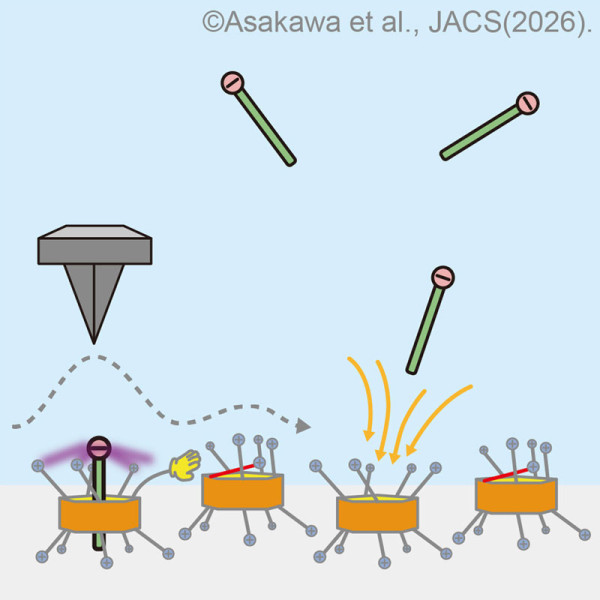
Kyoto, Japan -- A collaborative research team from Kanazawa University and Kyoto University reports the successful visualization of how densely assembled macrocyclic host molecules cooperatively capture guest molecules on a surface. Using two advanced atomic force microscopy techniques, AFM, the team directly observed host-guest complex formation as well as reversible association-dissociation dynamics at the single-molecule level.
The study reveals that when one macrocyclic molecule captures a guest molecule, this event influences neighboring host molecules and promotes further guest capture. This cooperative behavior emerges only when the host molecules are densely assembled on a surface. The findings provide new insight into how surface-confined molecular interactions give rise to cooperative behavior and could contribute to the design of next-generation chemical sensors, separation systems, and storage materials.
Reversible association and dissociation processes are fundamental to the function of many molecular systems and play key roles in applications such as chemical sensors, separation materials, pharmaceuticals, and energy-related materials. Host-guest complexation, in which a host molecule selectively captures a guest molecule, provides a representative model for studying these processes. Host-guest interactions have mainly been studied in solution using techniques such as NMR, calorimetry, and spectroscopy, which provide averaged information rather than direct observation of individual molecules.
However, in functional materials and devices, host molecules are often immobilized on solid surfaces, where densely assembled neighboring molecules can strongly influence one another. To understand such surface-specific behavior, techniques that can visualize association and dissociation at the single-molecule level are needed. In this study, the research team employed two AFM techniques to investigate host-guest complex formation on a substrate: frequency modulation AFM, which provides high spatial resolution, and high-speed AFM, which visualizes dynamic processes.
The research team used pillar[5]arene (P[5]A), a ring-shaped host molecule with a nanoscale cavity, densely assembled on a substrate. Frequency modulation AFM visualized structural changes of 100 picometers or less caused by guest capture and revealed that the complexes were not uniformly distributed. Instead, guest binding at one host molecule promoted further binding at sites about 3 nanometers away, indicating cooperative behavior. Molecular dynamics simulations suggested that this behavior originates from interactions and steric constraints among densely assembled host molecules. High-speed AFM further revealed repeated association and dissociation of individual complexes, with lifetimes ranging from milliseconds to seconds. These results show that reversible host-guest binding can be directly visualized at the single-molecule level.
The findings in this study show that new molecular functions, which emerge only when functional molecules are densely assembled on substrates, can be understood at the single-molecule level using two AFM techniques. The insights gained from this work provide important guidelines for the precise design of functional molecules and their assembled states. They are also expected to contribute to the development of next-generation functional materials and molecular devices.
【DOI】
https://doi.org/10.1021/jacs.6c00891
【KURENAI ACCESS URL】
http://hdl.handle.net/2433/301309
Hitoshi Asakawa, Hiroka Hatano, Shixin Fa, Takashi Sumikama, Mikihiro Shibata, Shu Takashima, Moe Ogasawara, Akio Ohta, Tada-aki Yamagishi, Tomoki Ogoshi (2026). Cooperative Host–Guest Complexation in Densely Assembled Host Structures on Surfaces Revealed at the Single-Molecular Level. Journal of the American Chemical Society, 148, 22, 22541-22551.


