

Kyoto, Japan -- The Covid-19 lockdowns were difficult for everyone. Many people were stuck at home all day every day dealing with their uncertainty for the future, and some found it hard to avoid frequent eating and snacking habits during lockdown. For many, the effects of this were marginal, but the risks in such a situation are higher for people with glucose intolerance, a group of metabolic conditions that includes diabetes.
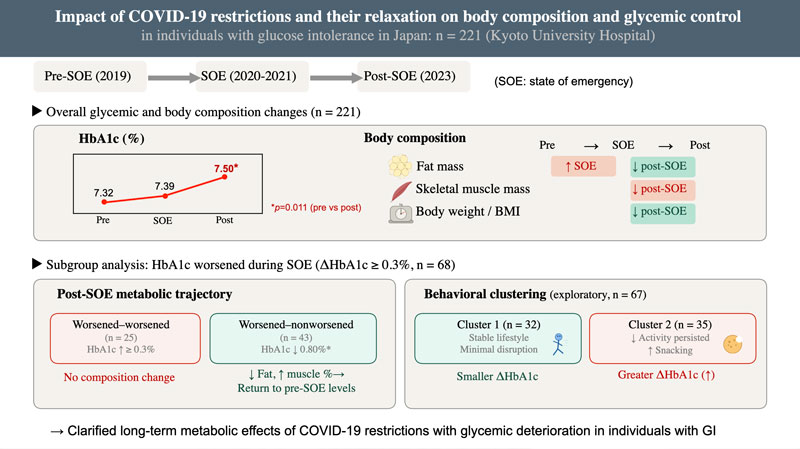
Previous studies examining glycemic control in individuals with glucose intolerance during the Covid-19 pandemic have reported mixed results: some showed worsening control while others found no significant changes. In one specific study on individuals in Japan, a team of researchers at Kyoto University found that the state of emergency led to increases in body weight, fat mass, and snacking frequency, all of which were associated with deteriorating glycemic control.
However, the researchers recognized that the longterm metabolic effects of this after the full relaxation of behavioral restrictions has remained unclear. This gap in knowledge motivated the team to explore the post‑restriction period in greater depth.
"While many studies examined metabolic changes during the restrictions themselves, very few investigated what happened afterward -- whether individuals were able to recover metabolically once daily life resumed -- and what distinguished those who improved from those who did not," says first author Ami Kobayashi. "As healthcare professionals, we felt it was crucial to understand these long-term trends to better support our patients reclaim their health."
The team recruited 221 outpatients with glucose intolerance who also had complete data for their glycated hemoglobin levels, or HbA1c, and body composition, such as body weight and fat mass, for the three periods before, during, and after the state of emergency. During the latter period, the researchers administered a questionnaire to the participants to evaluate their lifestyle changes.
The team was surprised to observe a clear divergence in clinical trajectories among individuals whose glycemic control initially worsened during lockdown. Some patients showed improvements in HbA1c and body composition afterward, while others exhibited a persistent deterioration. Questionnaire analysis identified different behavioral patterns between these groups, revealing that those who decreased physical activity and increased their snacking habits saw greater increases in their HbA1c levels after the state of emergency.
"This contrast highlighted for us how crucial flexible lifestyle adaptation is for restoring metabolic health," says co-author Yamato Keidai.
"The results demonstrate the long-term metabolic effects of the behavioral restrictions and their relaxation in individuals with glucose intolerance, and emphasize the variability of these effects across different patient groups," says team leader Takaaki Murakami. "This study also suggests that early identification of lifestyle and body composition changes, together with personalized support tailored to each patient's circumstances, may help improve long-term glycemic control."
【DOI】
https://doi.org/10.1111/jdi.70307
Ami Kobayashi, Yamato Keidai, Takaaki Murakami, Ryo Tsukaguchi, Miharu Fujita, Keiko Wada, Daisuke Yabe (2026). Impact of COVID-19 restrictions and their relaxation on body composition and glycemic control in individuals with glucose intolerance in Japan: A single-center observational study. Journal of Diabetes Investigation.


