

Researchers
研究者名
Hinako Asakura
研究者名
Sato, Takuya
Overview
Kyoto, Japan -- Like many parasites, nematomorphs are known to manipulate the behavior of their hosts to complete their life cycles. Also known as horsehair worms, among other names, these creatures develop in their hosts' body cavities and lure their terrestrial arthropod victims into the water where the parasites then reproduce. Some species have even been observed to induce positive phototaxis, attracting the host toward horizontally polarized light reflected on the water's surface.
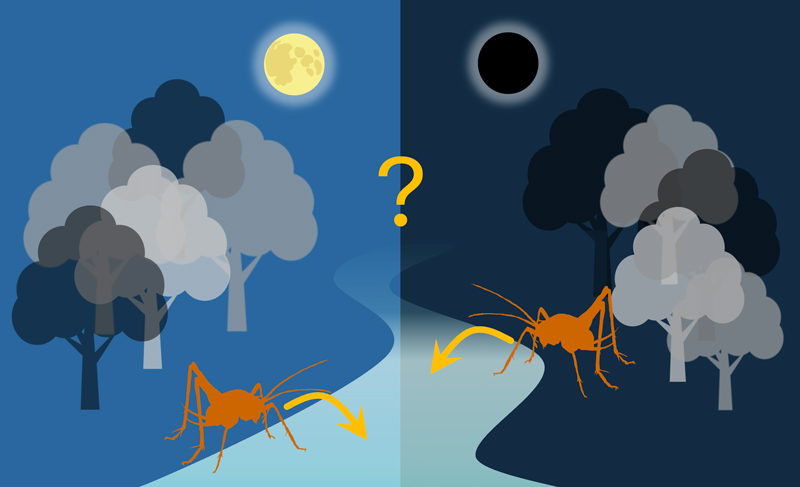
Given that some parasites, including nematomorphs, target nocturnal hosts, a team of researchers at Kyoto University wondered if parasites manipulate their nocturnal hosts in sync with the lunar cycle. If such a manipulation mechanism has been conserved across nematomorph lineages, the team hypothesized that water-entry behavior in nocturnal hosts infected by Gordius and Gordionus nematomorphs may be more prevalent during the full moon, and sparse during the new moon.
From August to October during nights of the full and new moon, the researchers sampled camel crickets floating on the water in a small artificial pond in the Kiso River system in Nagano prefecture, where they also found large numbers of nematomorphs. In addition, they examined the stomach contents of salmonid fish in a nearby forested stream, treating the fish as fellow field researchers that continuously survey the river, day and night.
Eventually, the scientists observed that camel crickets entered the water on both full and new moon dates. They did find that the number of crickets ingested by salmonid fish was significantly higher at night than during the day, but observed no significant difference in the number of crickets ingested on the full and new moon nights. These results indicate that nematomorphs do indeed manipulate their nocturnal hosts at night, but not in alignment with the lunar cycle.
"We were surprised to find that the manipulation was not synchronized with the lunar cycle, but this may be adaptive," says first author Hinako Asakura. "If host manipulation depended heavily on inducing positive phototaxis, there would be nights -- such as new-moon or cloudy nights -- when light reflected from the water's surface would be insufficient to effectively lure nocturnal hosts."
These findings suggest that nematomorphs may instead employ alternative manipulation strategies that are less dependent on light conditions and do not alter a nocturnal host's phototaxis. Two possible alternative strategies are altered geotaxis, an organism's response to gravity, and increased locomotor activity, which can be characterized as hyperactivity. Next, the research team plans to investigate these possibilities to understand whether different nematomorph lineages have evolved various mechanisms that trigger the same behavior in hosts with contrasting biological rhythms.
"It's important to recognize that many mysteries still remain about the mechanisms underlying host manipulation, and it is fascinating to think that parasites may have evolved different ways to achieve the same remarkable outcome: causing terrestrial arthropods to enter the water," says team leader Takuya Sato.
【DOI】
https://doi.org/10.1002/ecy.70475
Hinako Asakura, Takuya Sato (2026). Nocturnal host manipulation by nematomorphs is not synchronized with the lunar cycle. Ecology, 107, 9, e70475.


