
Researchers
研究者名
Takeda, Kazuyuki
Overview
Kyoto, Japan -- A diamagnetic substance is slightly repelled by magnetic fields: with a strong enough magnet, the diamagnetic force can override gravity and the substance will float in the air. Graphite, the main component of pencil lead, is considered one of the best substances for such real-world levitation, and its potential application in sensing weak external perturbations is drawing growing interest.
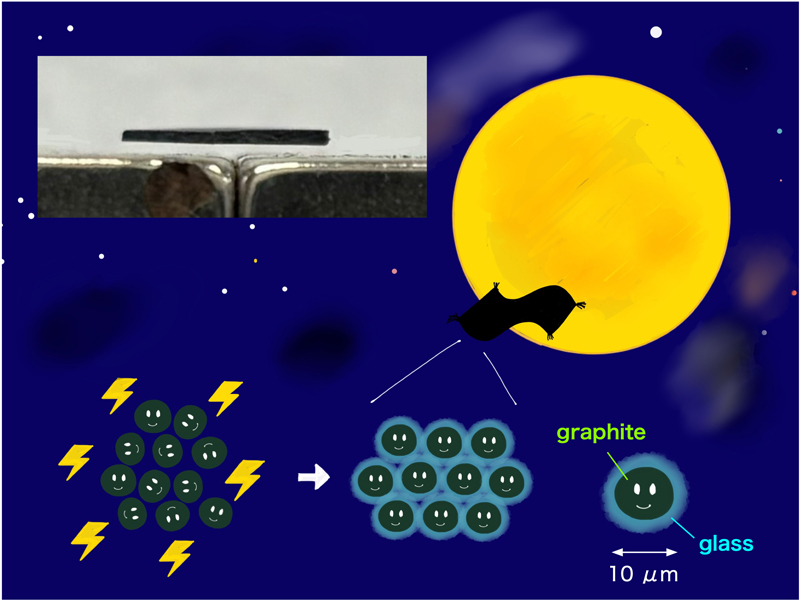
Until recently, graphite's electric conductivity posed an obstacle, as electric currents suppress this levitation. Previous research has found that a glass coating blocks the current efficiently, but also causes the particles to point in all directions, weakening the lifting force.
Serendipitously, a team of researchers at Kyoto University happened to be developing a possible solution, making single-crystal equivalents of various substances out of fine powders by aligning micro-crystals in a uniform direction. Though the scientists specialize in nuclear magnetic resonance spectroscopy, once they came across the graphite levitation issue, they realized that they could make a substantial contribution to solving this conundrum.
"I was drawn to diamagnetic levitation as I found the phenomenon to be somewhat counter-intuitive and even exotic," says corresponding author Kazuyuki Takeda. "I am amused by an object floating silently without any active drive, unlike a bird flapping its wings."
The team was already capable of aligning diamagnetic particles in a single direction. The trick is to focus on the particles' orientation-dependent energy and design a magnetic field with a favorable energy minimum aimed at directing the particles in a specific orientation. To apply this to graphite, the scientists first used chemical synthesis to add a thin layer of glass to each particle's surface, then mixed the particles with viscous water into a slurry and poured it into a mold with a superconducting magnet. They rotated the dish at the optimum turn speed to achieve the right viscosity and magnetic field that would orient the particles in the same direction, and then let the slurry dry into a stiff plate.
With this experiment, the team successfully created a hybrid graphite-based substance in which the particles are both insulated and aligned. When they tested its diamagnetism, the plate demonstrated stable levitation above permanent magnets. Suppressing graphite's electric conductivity allowed the plate to oscillate persistently for a long time, resembling a miniature flying carpet.
The researchers are eager to connect this study with a new strategy for nuclear magnetic resonance and magnetic resonance imaging -- MRI -- based detection. This finding has also revealed itself to be a promising platform for sensing applications, for which the team's levitating substance has already demonstrated important potential.
"An actual earthquake hit us while we were recording the motion of the levitating plate. As it bobbed up and down we detected a huge impulse," says Takeda. "This unintentionally became our first 'quake-sensing' event."
【DOI】
https://doi.org/10.1002/anse.70099
【KURENAI ACCESS URL】
http://hdl.handle.net/2433/302395
Tomoya Kamide, Ayuto Tatsubo, Jason Twamley, Kazuyuki Takeda (2026). Diamagnetically Levitated Sensing Platforms Made With Surface-Insulated and Magnetically Aligned Graphite Particles. Analysis & Sensing, 6, 4, e70099.


