

Kyoto, Japan -- Bright colors in animals are beautiful but often considered risky because they are more obvious to predators. However, conspicuous colors can also serve defensively, signaling toxicity or even luring predators away from more vulnerable body parts.
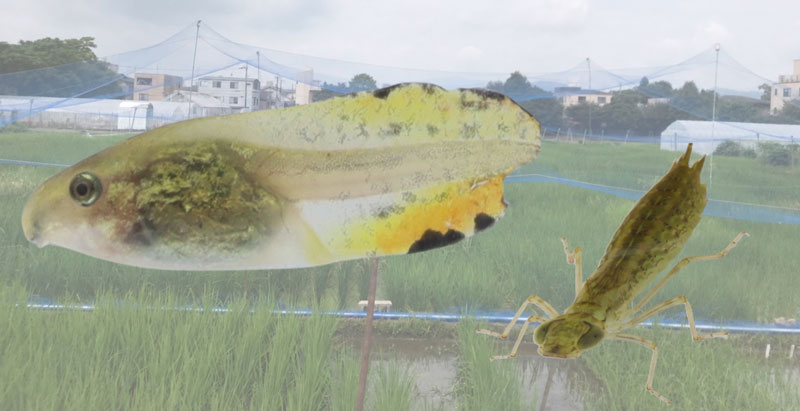
Previous studies have shown that the presence of predators such as dragonfly nymphs can induce tadpoles to develop bright orange tail coloration, an ability called phenotypic plasticity. But how this color change helps them avoid predation has not been clear. While observing tadpoles of the East Japan tree frog, Dryophytes leopardus, a team of researchers at Kyoto University was inspired to investigate how their predator-induced orange tails function as a defensive trait.
"After seeing these tadpoles with orange tails at the university's experimental farm, I wondered what role such a bright tail could have," says corresponding author Akihiro Noda.
In nearly 100 tanks the team prepared two groups of the tadpoles: four that had developed orange tails after exposure to dragonfly larvae, and four that had not been exposed to predators and thus had normal tails. Along with the eight tadpoles, the team placed a nymph of the blue-spotted emperor dragonfly, Anax nigrofasciatus, in each tank and recorded the predatory behavior on video. Then the scientists examined which tadpoles and which body parts the nymphs attacked, classifying each attack into one of three categories: miss, bite, or predation.
The results revealed that the nymphs attacked the orange tails more frequently than other tadpole body parts, and that these attacks were more likely to fail and leave the tadpoles uninjured than other attacks. This suggests that the vivid orange tail functions to lure the predator away from more vulnerable parts, deflecting more deadly attacks. Furthermore, rather than serving as a disposable body part, the tail may actually reduce the accuracy of attacks by interfering with a predator's ability to capture the tadpole.
"One possible mechanism is an effect known as motion dazzle, which occurs when conspicuous moving patterns or colors make it difficult for a predator to judge the direction or speed of its prey," says Noda. "The way the orange tail moves when the tadpole swims may make it harder for dragonfly nymphs to aim accurately."
These findings demonstrate that conspicuous coloration can be beneficial when it helps redirect predator attacks towards less vital parts of the body, contributing to our understanding phenotypic plasticity. Future studies will need to examine whether the orange tails are also effective against other predators, and how this tail is produced.
"This experiment required us to record a lot of video and repeatedly observe the predatory behavior of dragonfly larvae, sometimes in slow motion and sometimes frame by frame," says co-author Katsutoshi Watanabe. "It was painstaking work, but I'm glad it led to such clear and interesting results."
【DOI】
https://doi.org/10.1163/15685381-bja10258
【KURENAI ACCESS URL】
http://hdl.handle.net/2433/303189
Akihiro Noda, Katsutoshi Watanabe (2026). A cloakwork orange: lure and deflection effects of predator-induced bright tail colouration in Dryophytes tadpoles. Amphibia-Reptilia, 47, 2, 179-194.


