

Kyoto, Japan -- A hallmark of Type 2 diabetes is the progressive loss of beta cell mass: cells in the pancreas that produce and release insulin. The endoplasmic reticulum stress response, a cellular pathway that maintains protein homeostasis, plays a critical role in beta cell function and survival, and the protein ATF6α is one of the key regulators of this stress response. However, the significance of ATF6α signaling in the stress-adaptive regulation of beta cell mass has remained unclear, prompting a team of researchers at Kyoto University to investigate.
"Our previous single-cell RNA-sequencing data suggested transient ATF6α upregulation during adaptive beta-cell proliferation, which sparked our interest in its potential role," says first author Daisuke Otani.
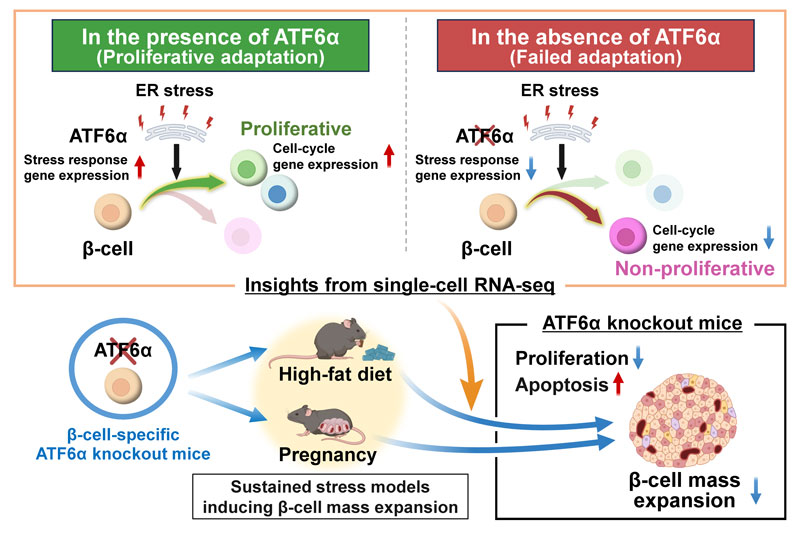
The team generated mice lacking ATF6α, specifically in beta cells. They assessed beta cell mass, proliferation and apoptosis, or cell death, of the mice under chronic stress conditions, including high-fat diet and pregnancy. The team also performed complementary in vitro experiments using chronically stressed beta cell lines, and single-cell RNA sequencing using the high-fat diet model.
The results revealed that loss of ATF6α consistently reduced beta cell proliferation and increased apoptosis, leading to impaired beta cell mass expansion under sustained stress across in vivo and in vitro models. These findings demonstrate the role of ATF6α in enabling the survival and proliferation of beta cells under sustained stress, establishing the protein as a central regulator of stress-adaptive expansion of beta cell mass.
"We were particularly intrigued to find that ATF6α signaling was commonly required for both beta cell survival and proliferation in two distinct in vivo models, while having minimal effects under normal physiological conditions," says Otani.
This study provides a novel insight into how endoplasmic reticulum stress-related pathways support pancreatic beta-cell adaptation by coordinating survival and proliferation under chronic stress.
The team next plans to explore the downstream pathways regulated by ATF6α and to evaluate the potential of targeting this pathway for therapeutic intervention. Whether these findings from mouse models can be recapitulated in human beta cell models will also be investigated.
"Our findings highlight the potential for developing new therapeutic strategies aimed at preserving and restoring beta cell mass in diabetes," says the corresponding author Takaaki Murakami." We will further continue to elucidate this mechanism and advance efforts toward the development of innovative treatments with the ultimate goal of achieving a cure for diabetes."
【DOI】
https://doi.org/10.2337/db26-0048
Daisuke Otani, Takaaki Murakami, Muhammad Fauzi, Ainur Botagarova, Sho Sekito, Hisato Tatsuoka, Shinsuke Tokumoto, Ryota Usui, Masahito Ogura, Taro Toyoda, Yasuhiro Murakawa, Daisuke Yabe, Nobuya Inagaki (2026). Activating Transcription Factor 6α Governs Stress-Adaptive Pancreatic β-Cell Mass Expansion by Coordinating Proliferation and Survival. Diabetes, db260048.


