From 26 to 28 October 2026, Kyoto University hosted 38 undergraduate and graduate students and two accompanying faculty members from India as part of the "MIRAI-Setu 2026" program. The students represented four institutions: the Indian Institutes of Technology (IIT) Hyderabad, IIT Madras, IIT Guwahati, and the Indian Institute of Information Technology, Design and Manufacturing, Jabalpur (IIIT DM, Jabalpur).
Organized by Japan's Ministry of Foreign Affairs, the MIRAI-Setu program invites outstanding undergraduate and graduate students from India to spend approximately one month in Japan engaging in corporate internships and academic interactions at universities. Its aim is to promote exchanges of talent and strengthen ties between Japan and India, with "Setu" in its name meaning "bridge" in Hindi.
The first day's activities took place on Yoshida Campus. The students received an overview of the University's graduate admissions process from the Admissions Assistance Office (AAO) and attended presentations on career opportunities in Japan and India, delivered by KyotoU students who had participated in a summer program at IIT Hyderabad earlier this year. The presentations were followed by discussions. The group then went on a campus tour led by KyotoU students who had taken part in the 2025 and 2026 IIT Hyderabad summer programs. Afterwards, the MIRAI-Setu participants visited the Center for iPS Cell Research and Application (CiRA), where they toured open laboratory spaces and received briefings on the latest research developments, gaining firsthand insight into the forefront of regenerative medicine.
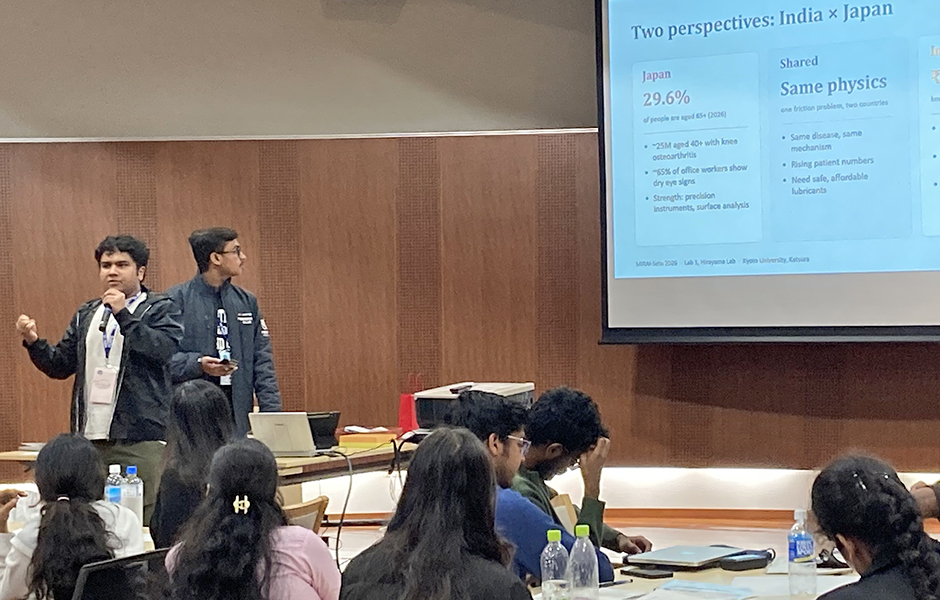
On the second day, the participants visited Katsura Campus, where they were divided into five groups, each of which toured one of the following laboratories at the Graduate School of Engineering: Machine Element and Functional Device Engineering; Thermal Science and Engineering; Nano/Micro System Engineering; Applied Quantum Electronics; and Applied Electrochemistry. With support from the Engineering Education Research Center (ERcenter), they also took part in a Japanese cultural activity (making New Year's cards, or nengajo), a networking lunch hosted by the center, and the "Spaghetti Tower Challenge". The afternoon featured the "India × Japan Co-Creation Challenge", where the participants, drawing on the insights gained during their morning laboratory visits, discussed solutions to social issues and delivered pitch presentations.
On the final day, after exploring the academic exhibitions at the Kyoto University Museum, the group attended reflection and networking sessions with KyotoU students who had taken part in the 2025 and 2026 IIT Hyderabad summer programs.
Throughout their visit, the students from India gained firsthand exposure to Kyoto University's cutting-edge research environment and interacted directly with Japanese students who had visited their home country. It is hoped that these experiences will encourage these highly talented individuals and their peers to consider pursuing further studies and research careers at Kyoto University.