
Hiroshi MATSUMOTO, the 25th President
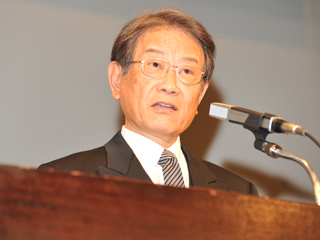
3,013 new students who came today to Miyako Messe, which stands in twirling cherry blossom petals, “Congratulation and welcome to Kyoto University.” I would like to cerebrate this delightful day together with the university’s ex-Presidents Toshio Sawada and Yasunori Nishijima, former President Kazuo Oike, professors emeritus, vice President and Faculty Deans, I would like to cerebrate this delightful day. I assume you have carried yourselves up the long, tough road towards entrance examination. I truly respect you for your diligence. I’d also like to extend my heartfelt congratulations to their families, teachers and friends who have supported them.
Well, first of all, I would like to say a few words to students who successfully entered Kyoto University. It is about our university’s academic freedom. Kyoto University’s basic ideas and policies begin with a mission statement, which reads:
Kyoto University states its mission to sustain and develop its historical commitment to academic freedom and to pursue harmonious coexistence within human and ecological community on this planet.
I strongly recommend that you read it for yourself.
What lies at the base of this statement is the spirit of “independence and self-reliance” and it intends to mean that we hope our students to take responsibilities for themselves and study proactively and independently as adults. I may be stating the obvious but I’m going to say this, please make sure you never misunderstand the concept of “freedom.” Freedom is not a synonym for “footloose” or “self-indulgence.” How I interpret Kyoto University’s freedom is to think liberally without being restricted by conventional concepts that exists within and outside of your mind, value your own originality and allow your individuality to shine through you. You, as an individual, without being tied down by existing concepts and systems, should act on your liberal ideas while always being considerate to society and people who surround you and adhering to responsible attitude. Moreover, once you have made a free choice, you take responsibility for your choice and make every effort to carry through what you chose to do. Freedom, which incorporates all of the above, is the freedom Kyoto University upholds. Liberal academic culture was formed as our past students who acquired such responsible freedom graduated from the university, then, they entered the real world, played active roles in various fields and achieved unique successes and results.
Up until today, your life as students preparing for entrance examinations must have been tough. At the same time, you are also aware that in some respects you’ve been waling on the “yellow brick road.” However, such learning habit is not good enough to fully enjoy the freedom of Kyoto University. During your time at our university, what I think you need to do is, what we call, “un-learning.” You need to reflect on your past and rearrange your past learning style, once you started the university life.
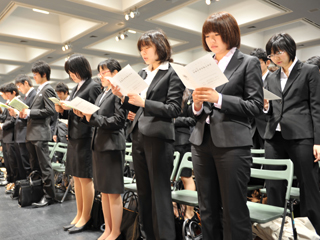
You are going to immerse yourselves in university education. It is so different from high school education that you may become confused. So far, the education you had required you to learn the teachings of our predecessors. Therefore, you always had answers. This learning stage is known as, “learning by listening,” that is, to acquire knowledge by listening. However, in order to receive university education, you need to go beyond it. You built educational foundation up until now through “learning by listening.” From now on you’ll need to develop on that foundation your own deep thoughts on a subject, through firstly “learning by thinking,” and then “learning by practicing. You won’t get a single correct answer all the time. For many of the problems we have, at least at this point, we don’t have answers. It isn’t even clear how we should go about solving them. However, this staged education method of “listen-think-practice,” a methodology for arts and sciences, was utilized from the dawn of civilization and 1200 years ago, a Japanese monk, Saicho (also known as Dengyo Daishi), were known to employ this education method for his monk’s school at Mt. Hiei. I believe this methodology will give you a great power. You need to acquire this great power as soon as possible. You cannot acquire genuine academic knowledge through passive learning. I believe you are, in the future, going to play key roles in various fields as leaders on only in Japan but also in the world. For that, I hope you will hungrily learn a wide range of seemingly useless education and surrounding knowledge as culture, in addition to the acquisition of basic and application knowledge and technology of the subject you major in, judge everything pluralistically and acquire skills to get an insight into the true nature of a matter.
In relation to what I’ve just said, I would like to say one thing to you who are in the bloom of youth. The period of bloom of youth is one of the most precious and valuable stagess in life. However, at the same time, it is also the most dangerous stage in life. An excellent essay book, “Guzo Saiko” (Idol Reemergence), was written by Professor Tetsuro Watsuji, a philosopher and former Kyoto University professor, in his late 20s. One essay titled, “Cultivate every shoot” is in the book. In his wonderful essay the professor describes mental characteristics of youth as succulent and supple while pointing out the danger that simultaneously exist during the bloom of youth – danger of being overwhelmed by direct human lust, which bubbles up on you and confuses you as your body reaches its prime. He compares these momentums of youth with the new shoots of various trees. Professor Watsuji states that it is vital to prevent these shoots from growing the wrong way through seeking only internally and readily available excitements. He advises to provide with only appropriate nutrients that help the shoots grow well. He describes that such nutrients are art, philosophy, religion and history that humankind created and through absorbing these spiritual treasure, you can obtain balanced intelligence. He advises that one should cultivate every shoot that symbolizes youth on a different dimension, while aspiring for higher education. I absolutely agree with him. I hope that you acquire intelligence here at Kyoto University that sparkles when you reach middle and senior age.
Learning opportunities at Kyoto University are there for students who proactively advance towards a path of seeking truth. However, during the course, you may sometimes need to dense and intense exchange of ideas. Never give up, never forget to respect the other person’s position and opinion even during “vigorous dialogue” and never forget to value yourself, in other words, please try to respect and look after yourself. Teachers at Kyoto University pay full attention to anyone who try to learn an unknown subject, as a senior who has walked the same path. Kyoto University also offers a variety of curriculum. I hope that you won’t choose an easy path of learning. I would like to share with you a quotation of a French poet, Jean Cocteau, “A young man should never purchase a safe stock.
I would like all of you here to become educated as international intellectuals, while acquiring knowledge as specialists and capabilities to observe the future world from various angles. To accomplish this, I would like you to spend a lot of time on reading books during your university life, which you are going to start very soon. I would like you to broaden your horizon through extensive reading and think deep, make improvements on yourself and become able to deal with complex and pluralistic problems through intensive reading. Please do not always go for easy option and access information on the Internet. I would like you to cultivate your mind through reading a broad range of literatures beyond humanity and science and make a journey beyond space and time. Meet the wise of ancient times and befriend with ancestors of the world. To do that, linguistic skills are equaly important. Our university is a great place for learning various foreign languages. An international person has to be fluent in an international language. The experience of learning a foreign language will become a great advantage when you re-learn it later on, even if you forget what you learned in the past.
Currently, there are approximately 3,000 teachers, 2,500 staff and 22,000 students in Kyoto University. I am certain that people you meet and relationships you build during your time in the university will enrich your life in the future. I hope that you actively try to build good relationship with many people – not only the people you meet in a class or through a research project but also the people you meet through club and other activities. We, as teachers and staff, will strive to improve the environment for university education and research, aiming for innovative, attractive, energetic and high-standard university, based on tradition. I would very much like to request families and officials who are here today for your continued support and cooperation to our university.
You are gathering here today as a result of overcoming a huge hurdle. Many of you must have decided on which path you are going to take to develop certain talent that you have. However, some of you may be unsure of which path to take or some of you may be thinking that you are better off taking a different path to what you planned before entering the university. Learning ability is not the only talent. Figuratively speaking, there is a direction your tree can grow well and you will find the direction not in the plain 2π but somewhere in solid 4π. I hope the tree that you grow is not simply a tree that bears beautiful flowers but also an “ever green” that can grow well under harsh and cold conditions. Please take your time and find your unique direction, during your time at Kyoto University.
I would like to conclude my speech by hoping that you’ll take good care of your own health, become psychologically and physically strong and make great efforts in learning. Also I hope that you meet new friends, talk a lot with them, look at various opportunities including extracurricular and volunteer activities, and generally try your best in everything.
Congratulations on entering Kyoto University.