

July 4, 2013

Assist. Prof. Terao
Two novel susceptibility genes to Takayasu Arteritis were identified by a research group led by Dr. Chikashi Terao, Assistant Professor, and Dr. Fumihiko Matsuda, Professor, Center for Genomic Medicine, and Dr. Hajime Yoshifuji, Assistant Professor, Kyoto University Hospital, and Dr. Tsuneyo Mimori, Professor, Department of Rhematology and Clinical Immunology, Kyoto University Graduate School of Medicine.
This study was published in American Journal of Human Genetics on July 4th, 2013.
Summary of Findings
- Two novel susceptibility genes to Takayasu Arteritis (TAK), namely, IL12B and MLX, were identified through a genome-wide association study performed for the first time for this disease.
- A synergistic effect for susceptibility to TAK was found between IL12B polymorphism and HLA-B*52:01, an established susceptibility gene to TAK.
- IL12B polymorphism was associated with aortic regurgitation (AR), a representative complication in TAK, severity of AR, and disease activity of TAK as well as TAK susceptibility.
What is Takayasu Arteritis?
Takayasu Arteritis (TAK) was reported for the first time by Japanese ophthalmologist, Prof. Migito Takayasu in 1908. TAK affects especially young women aged between 15 and 35. TAK is characterized by the involvement of large arteries especially the aorta and its large branches. Individuals with TAK develop a wide range of symptoms such as fatigue and lowering of vision in addition to its characteristic complications including aortic regurgitation (AR), pulseless and difference of blood pressure between right and left upper limbs (so it is also called 'pulseless disease'). Although corticosteroid and immunosuppressant are often used for treatment of TAK, TAK often flares up during treatment.
Previous studies have revealed that genetic components are involved in the pathogenesis of TAK, and HLA-B*52:01 is so far the only established genetic factor across the world.
Research
The research group performed a genome-wide association (GWA) study of 167 TAK cases and 663 healthy controls and identified six candidates of susceptibility loci (Figure 1). We also performed a replication study consisting of 212 TAK cases and 1,322 controls. As a result, we found that the IL12B region (overallp=1.7x10⁻¹³) and the MLX region (overallp=5.2x10⁻⁷) as well as the HLA-B region (overallp=2.8x10⁻²¹) as susceptibility loci to TAK. IL12B encodes IL12p40 protein, a subunit of well-known inflammatory cytokine. MLX encodes a transcription factor whose significance is unknown. We also found a synergistic effect between the IL12B polymorphism and HLA-B*52:01. Those who were positive for both IL12B polymorphism and HLA-B*52:01 had odds ratio of 6.00 (95% confidence interval (CI):4.22-8.55), while those who were positive only for HLA-B*52:01 or the IL12B polymorphism showed OR of 1.80 (95%CI:1.11-2.93) or 1.74 (95%CI:1.23-2.47), respectively (Figure 2). In addition, we found that the IL12B polymorphism showed a significant association with clinical manifestations of TAK, including increased risk and severity of AR, a representative severe complication of TAK.
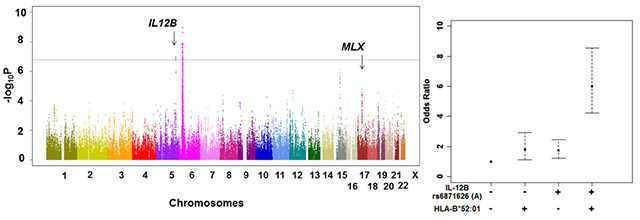
(left)Fig1. Results of genome-scanning. X:Chromosomal position Y: Strength of association.(right)Fig2. Synergistic effect between IL12B and HLA-B*52:01.(Terao C, Yoshifuji H, et al, Am J Hum Genet. 2013)
Significance of Findings
This is the first GWA study for TAK in the world. Low prevalence of this disease had made it difficult to collect DNA samples to obtain sufficient power to detect susceptibility genes and perform a GWA study.
The associations between the IL12B polymorphism and clinical manifestations of TAK suggest the fundamental effects of IL12p40 protein on TAK progression as well as TAK onset. Previous studies have revealed that the IL12B region was associated with a wide variety of autoimmune disorders and infectious diseases, including psoriasis, inflammatory bowel diseases, and leprosy. Their findings indicate that common autoimmune mechanisms underlie the pathology of TAK and other autoimmune disorders such as psoriasis and inflammatory bowel diseases in which IL12B is involved as a genetic predisposing factor. Detection of these susceptibility loci will provide new insights to the basic mechanisms of TAK pathogenesis.
Future Plan
The research group is planning to analyze how IL12p40 exerts its effect on TAK pathology, using patients' samples.
Further genetic analyses are under way to detect further susceptibility genes to TAK.
This study was done by the multi-center research group composed of Center for Genomic Medicine and Department of Rheumatology and Clinical Immunology, Graduate School of Medicine, Kyoto University, Kyoto University Hospital, Tokyo Medical and Dental University, Graduate School of Medicine, The University of Tokyo, Niigata University Graduate School of Medical and Dental Sciences, and Tokyo Women's Medical University, Jichi Medical University, and Osaka Red Cross Hospital.
Paper Information
Authors
Terao C, Yoshifuji H, Kimura A, Matsumura T, Ohmura K, Takahashi M, Shimizu M, Kawaguchi T, Chen Z, Naruse KT. Sato-Otsubo A, Ebana Y, Maejima Y, Kinoshita H, Murakami K, Kawabata D, Wada Y, Narita I, Tazaki J, Kawaguchi Y, Yamanaka H, Yurugi K, Miura Y, Maekawa T, Ogawa S, Komuro I, Nagai R, Yamada R, Tabara Y, Isobe M, Mimori T, Matsuda F.
Title
Two susceptibility loci to Takayasu arteritis reveal a synergistic role of the IL12B and HLA-B regions in a Japanese population. Am J Hum Genet. 2013