

March 20, 2012
The finding of the international research team, including Prof. Tetsuro Matsuzawa of the Primate Research Institute, was published in the journal Current Biology.
| An adult male chimpanzee carries three papayas during crop-raiding. Researchers conclude that chimpanzees adopt a bipedal posture in locomotion to maximise the efficiency of their resource-gathering when competition is fierce – and our early ancestors may have done the same. |
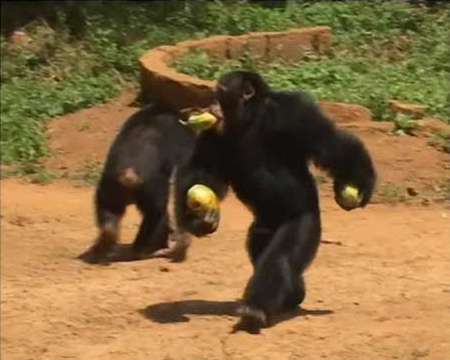
Our earliest ancestors may have started walking on two limbs instead of four in a bid to monopolise resources and to carry as much food as possible in one go, researchers have found.
A study published in the journal Current Biology today (March 20, 2012), investigated the behaviour of modern-day chimpanzees as they competed for food resources, in an effort to understand why our "hominin", or "human-like" ancestors became bipedal.
Its findings suggest that chimpanzees switch to moving on two limbs instead of four in situations where they need to monopolise a resource, usually because it may not occur in plentiful supply in their habitat, making it hard for them to predict when they will see it again. Standing on two legs allows them to carry much more in one go because it frees up their hands.
An international team of researchers from England, Japan, Portugal, and the USA, led by PhD student Susana Carvalho (University of Cambridge), Dr. Dora Biro (University of Oxford), and Prof. Tetsuro Matsuzawa (Kyoto University), conclude that our earliest hominin ancestors may have lived in shifting environmental conditions in which certain resources were not always easy to come by. Over time, intense bursts of bipedal activity may have led to anatomical changes that in turn became the subject of natural selection where competition for food or other resources was strong.
Prof. William McGrew, from the Department of Archaeology and Anthropology, University of Cambridge, said: "Bipedality as the key human adaptation may be an evolutionary product of this strategy persisting over time. Ultimately, it set our ancestors on a separate evolutionary path."
Lack of evidence in the fossil record means that researchers remain divided over when these ancestors became bipedal. It is widely believed that they did so because of climatic changes, which reduced forested areas and forced them to move longer distances across open terrain more often.
The new research digs deeper, however, by attempting to explain what particular pressures within that context forced those hominins to modify their posture and resort to moving on their legs.
The team theorised that the reason for this change may have something to do with the need to transport resources with maximum efficiency. Because bipedal movement is sometimes observed in modern great apes, they decided to monitor the behaviour of chimpanzees and, if possible, determine when and why they resorted to moving on two legs.
Two studies were carried out. The first was in Kyoto University's "outdoor laboratory" in a natural clearing in Bossou Forest, Guinea. Here, the researchers allowed the wild chimpanzees access to different combinations of two different types of nut – the oil palm nut, which is naturally widely available, and the coula nut, which is not, so the latter is an "unpredictable" resource.
Their behaviour was monitored in three situations: (a) when only oil palm nuts were available, (b) when a small number of coula nuts was available, and (c) when coula nuts were the majority available resource.
When the rare coula nuts were available only in small numbers, the chimpanzees transported far more in one go. Similarly, when coula nuts were the majority resource, the chimpanzees ignored the oil palm nuts altogether. Clearly, the chimpanzees regarded the coula nuts as a more highly-prized resource and competed for them more intensely.
In such high-competition settings, the frequency of cases in which the chimpanzees started moving on two legs increased by a factor of four. Not only was it obvious that bipedal movement allowed them to carry more of this precious resource, but also that they were actively trying to move as much as they could in one go by using everything available – even their mouths.
The second study, by Dr. Kimberley Hockings (Oxford Brookes University) was a 14-month study of Bossou chimpanzees crop-raiding, a situation in which they have to compete for rare and unpredictable resources. Here, 35% of their activity involved some sort of bipedal movement, and once again, this behaviour appeared to be linked to a clear attempt to carry as much as possible in one go.
The study concludes that unpredictable resources, such as the coula nuts, are seen by chimpanzees as more valuable. When these resources are scarce and access to them is on a "first-come, first-served" basis, they are more prone to switch to bipedal movement, because it allows them to carry away more of the resource at once.
For our early ancestors, unpredictable access to vital resources may have been a frequent occurrence because of climatic shifts and rapid environmental change. Those who resorted to bipedal movement may have had an advantage, and gradually, anatomical change may have taken place as they used this strategy again and again. Once that happened, ability to move more easily on two legs may have become a selection pressure, so that over many generations, it became the norm.
Link to the journal paper:
http://dx.doi.org/10.1016/j.cub.2012.01.052
Susana Carvalho, Dora Biro, Eugénia Cunha, Kimberley Hockings, William C. McGrew, Brian G. Richmond, Tetsuro Matsuzawa.
Chimpanzee carrying behaviour and the origins of human bipedality. Current Biology, 22(6), R180-R181, 20 March 2012. doi:10.1016/j.cub.2012.01.052