

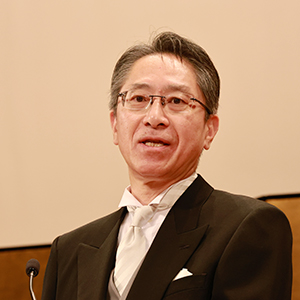
Yasuto Tachikawa, 28th President
Today, Kyoto University welcomes 78 students enrolling in master’s programs, 6 enrolling in professional degree programs, and 120 enrolling in doctoral programs.
On behalf of the executive vice-presidents, deans, and director who have joined us today, and all of the University’s faculty and staff members, I congratulate each and every one of you on your enrollment at Kyoto University.
As you join the Kyoto University community, I imagine you are filled with enthusiasm to master specialized knowledge and skills, embark on new research, and develop your practical capabilities.
Kyoto University warmly welcomes you.
I also extend my warmest congratulations to your families, and all those who have encouraged and supported you thus far.
Kyoto University was established in 1897 as Japan’s second imperial university and has since developed into a comprehensive, research-oriented institution.
At Kyoto University’s first entrance ceremony in September 1897, the first president, Dr Hiroji Kinoshita, stated a guiding principle for students.
He used the phrase Jichō Jikei, meaning "self-reliance and self-respect", emphasizing the importance of valuing and respecting oneself.
Rooted in that founding spirit of self-reliance and self-respect, a commitment to individual autonomy has been passed down within the university community as an institutional culture of academic freedom, driving free and original research. This is the tradition of Kyoto University.
You are all now about to embark on real research in your respective academic fields.
Kyoto University’s graduate schools cover a diverse array of disciplines.
Its eighteen graduate schools and approximately twenty affiliated research institutes and centers will provide the venue for your studies and research.
Master’s students are expected to build more specialized knowledge and skills by participating in advanced courses, building upon the foundational and specialized knowledge acquired during their undergraduate studies.
In addition to lectures, it is also vital to gain practical, hands-on experience through on-site practice and fieldwork.
Students in professional degree programs will receive, in addition to lectures, a more practically-oriented education through opportunities to learn from experts with real-world experience in their respective fields, including on-site practice, case studies, and field research.
Students enrolled in doctoral programs will work on their research topics, and advance their research in preparation for writing their dissertations.
To do this, it is essential to clarify the position of your research within the body of existing studies and clearly demonstrate its novelty and originality.
Through dialogue with your advisor and lab colleagues, you will formulate a research plan, discuss your analysis results to confirm what new findings have been obtained, and proceed with writing your dissertation in pursuit of your degree.
You are about to take on the challenge of learning and thinking with your own critical mind, and through dialogue with your professors and peers, tackling your own research topics in order to generate new knowledge that no one has discovered before.
As you begin this endeavor, I would like to share with you some things that I consider to be important.
The first crucial step is defining your research theme.
It is no easy task to establish a theme that pursues new knowledge or value -- something that no one has explored before.
This is particularly true for those who are just beginning a master’s program, as some of you may be embarking on research for the first time.
I imagine that some of you may not yet be certain where your aptitudes lie.
When I was a student, I also struggled to decide on a research theme.
To begin with, you should read review papers and attend laboratory seminars to learn about the research that others are conducting and to gain a deep understanding of existing research in each field.
It is also a good idea to seek advice from your advisor and other professors in related fields, and to gradually discover your own theme while working on an aspect of their ongoing research.
Defining your research theme is the most important starting point of the research process.
Please keep thinking about it, and search for a theme that suits you.
Once you’ve determined your research theme, the next step is to formulate a research plan.
This involves setting short-term goals that pave the way toward achieving your medium - to long term objectives.
Proceed with your research by tackling and overcoming immediate challenges one by one.
Presenting and discussing your findings at lab seminars and other opportunities will help deepen your research.
A unique sense of joy comes from achieving the results you had hoped for.
However, it is quite common -- and perhaps even the norm -- that results do not turn out exactly as we initially imagine.
In such cases, take the time to review your research process and consider why things did not go as planned.
Discuss it with your advisor and fellow lab members, and seek their advice.
As you deepen your learning in your own field of specialization, it is also important to broaden your interests in other fields.
Let me give you an example.
This past summer was, again, extremely hot.
In late June, numerous locations across Europe recorded peak temperatures exceeding 40°C.
Japan also experienced days of intense heat with temperatures exceeding 40°C.
In fact, the total number of observation sites in Japan that recorded temperatures above 40°C this summer reportedly exceeded last year’s annual record, marking an all-time high.
Researchers have pointed out that global warming may have contributed to these high temperatures.
Rising temperatures driven by global warming intensify the Earth’s water cycle, leading to an increase in atmospheric water vapor and a rise in short-term precipitation.
As the magnitude and frequency of heavy rainfall increase, so does the risk of water-related disasters.
To prevent or mitigate the damage expected from future water-related disasters, a comprehensive approach is essential.
This requires not only engineering solutions such as river improvements, but also more accurate weather forecasts, the development of flood-resilient communities, and the establishment of rapid recovery support systems.
Addressing such complex societal challenges requires us to consider how science -- encompassing the natural sciences, humanities, and social sciences -- can contribute to finding solutions.
This does not apply only to water-related disasters: tackling challenges such as environmental pollution, resource and energy issues, and infectious diseases requires knowledge from many different fields.
I encourage you to deepen your expertise in your respective fields while also broadening your interests in other disciplines.
I hope you will take an active interest in how your research topics relate to global-scale social issues.
You are now about to acquire specialized knowledge and skills and embark on your research activities.
I encourage you to cultivate the ability to learn and conduct research independently, and to devote yourselves to your work guided by your own free and creative thinking.
Kyoto University is committed to further enhancing its educational and research activities, as well as creating an environment where students can focus on their studies and daily lives.
We are also working to support graduates in finding employment in the private and public sectors and to expand opportunities for early-career researchers.
I hope that during your graduate studies at Kyoto University, you will meet many people, discover research themes that you are eager to pursue, and forge new paths through dialogue with professors and friends.
I hope that you will identify the specific "mountains" that you wish to climb, conquer them one by one, and reach to the highest peaks.
My heartfelt congratulations to you all on your admission to graduate school.