

Nagahiro Minato, 27th President
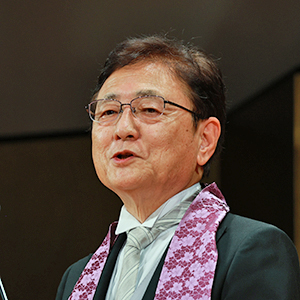
Today, Kyoto University is proud to award master's degrees to 95 students, professional master's degrees to 5 students, and doctoral degrees to 209 students. Of these graduates, 160 are from overseas. Let me begin by offering my sincere congratulations to all of you on your accomplishments.
With today's ceremony, Kyoto University will have awarded a cumulative total of 97,391 master's degrees, 3,030 professional master's degrees, 3,195 juris doctor degrees, and 50,543 doctoral degrees. On behalf of the University's faculty and staff, I would like to extend my congratulations to each and every one of you on receiving your degrees.
As of today, you are all holders of academic degrees from Kyoto University. In the early 1990s -- following the collapse of the so-called "bubble economy" of the mid-1980s and the onset of a rapid economic downturn -- the University Council of Japan's Ministry of Education, Culture, Sports, Science and Technology (MEXT) proposed doubling the number of graduate school entrants, leading to a shift in focus toward graduate education. This was a remarkably bold policy aimed at transforming the education and research structure of national universities throughout the country from the traditional undergraduate-centered model to a graduate school-centered one. I believe it reflected a strong political determination to foster highly specialized talent by strengthening academic research capabilities, and thereby regaining international competitiveness.
Just how many people were actually earning doctoral degrees in Japan at that time? Let us look at the Science and Technology Indicators 2026, published by MEXT's National Institute of Science and Technology Policy (NISTEP), which provides survey data to inform national science and technology policy-making. A quarter of a century ago, in the year 2000, the number of doctoral degree recipients per million population in Japan was 127. While this was lower than Germany's approximately 320 and the United Kingdom's approximately 200, it was roughly on par with France and South Korea. So, what was the situation twenty-three years later, in 2023? Germany, the UK, and South Korea all saw their figures rise well above 300, yet -- alarmingly -- Japan's figure remained stagnant at 124. A similar trend can be observed regarding the number of master's degree recipients, with Japan having the lowest figure among major developed countries. Japan's number of master's degree recipients per million capita is only about 9% of the figure for the UK and about 22% of the figures for Germany and the US. Compared to thirteen years ago, Japan has seen an increase of only 1%, whereas other countries have seen increases exceeding 10% -- notably, the UK figure has risen by 86% and China by 180%.
There is another notable characteristic regarding the number of doctoral degree recipients in Japan: the balance across academic fields. Looking at the 2023 academic year, the vast majority of doctoral degrees awarded in Japan were in the natural sciences, with those in the humanities and social sciences accounting for only about 9.1%. This figure is markedly lower than the approximately 20% seen in the US and Germany, and the figures of over 30% observed in France, the UK, and South Korea. It highlights the fact that Japan has an overwhelmingly small number of doctoral degree holders in the humanities and social sciences compared to other developed nations.
Why has the number of doctoral degree recipients in Japan not increased over the past nearly thirty years, despite the promotion of policies prioritizing graduate education at national universities? Various factors likely contributed to this, including the prolonged economic stagnation often referred to as the "lost thirty years", and the woefully inadequate financial support -- including scholarships -- available to graduate students. However, the single most significant factor appears to be the historical tendency for PhD holders in Japan to pursue careers almost exclusively in research positions at universities or public research institutions. For example, according to the 2026 Science and Technology Indicators, approximately 75% of PhD recipients went into universities and public research institutions, while only 15% entered the private sector. This may stem from the fact that, under Japan's post-war educational system, universities themselves viewed graduate education primarily as a training ground for academic faculty and researchers. However, as the number of faculty and research positions at universities and other institutions has not increased but has instead continued to decline, and as corporate research centers in the private sector have gradually been scaled back, this may have failed to boost students' motivation to pursue doctoral programs. In contrast, the career paths of PhD recipients in the US during the same period show a striking difference: the proportions entering universities and other research institutions and those entering the private sector were roughly equal, at approximately 42% each. This likely reflects the historical context of the US -- the birthplace of the graduate school system -- where PhD holders have long been regarded as a leading elite, playing active roles across all sectors of society, including politics, government, industry, the media, and NPOs.
Against this backdrop, a major shift is currently underway in Japan -- one that might be described as the "second wave of graduate school prioritization". This trend involves the implementation of various measures -- not only by universities but also by society as a whole, including the government and the business sector -- aimed at increasing the number of students entering graduate school and those earning degrees. Japan once astonished the world with its post-war recovery and development -- often referred to as the "miracle of the East" -- yet following the collapse of the bubble economy in the late 20th century, the nation endured a prolonged period of economic stagnation amidst rapid technological innovation and globalization. Amidst these circumstances, expectations for highly specialized talent with graduate-level education are rapidly rising across both the public and private sectors. This trend is evident in proposals such as MEXT's Get a PhD -- Doctoral Human Resources Action Plan, launched in 2024, and the document Towards the Realization of a Society in Which Doctoral Talent Can Thrive: A Vision and Specific Initiatives, issued this past February by the Council for Industry-Academia Collaboration on Doctoral Human Resources -- a body comprising representatives from national, public, and private universities as well as the Japan Business Federation. Furthermore, MEXT has begun significantly expanding its grant-based scholarship programs, while the industrial sector is establishing preferential hiring systems and internship programs for degree holders, thereby fostering an environment in which doctoral talent can fully contribute. All of these recent developments reflect society's high expectations for degree holders who have received the most advanced education. They highlight a growing consensus -- shared by the government, industry, and the nation as a whole -- that we must create an environment in which highly educated degree holders are not confined to academia but can fully utilize the skills they have acquired in graduate school and thrive across a diverse spectrum of sectors throughout society.
Until recently, the world was said to have entered the era of information technology (IT), and as the demand for computer programming talent surged, universities and vocational schools in the US worked to train large numbers of programmers. However, a recent CNN news report stated that tens of thousands of programmers who graduated from these programs are now struggling to find jobs. The reason, needless to say, is the rapid proliferation of generative AI. Because modern AI can instantly generate sophisticated, complex code, manual programming is barely necessary anymore. Now, we are indeed living in the age of AI, and the question of which jobs will disappear and which will survive has become a major topic of discussion. In an interview for the CNN news report, a veteran software engineer stated: "AI will not replace you as an engineer. An engineer with AI will replace you as an engineer."
While much of the current discussion seems to focus on exactly what AI can do and to what extent it can do it, I believe the truly important question is how meaningfully AI can contribute to people and society. Ultimately, it is not AI that will determine this, but rather we humans who use it.
The biography of Daniel Coit Gilman, the first president of Johns Hopkins University -- the first research-oriented graduate university, describes the PhD as the "protean PhD". In this era of unpredictable and unstable change -- including the expansion of AI -- I believe that it is precisely people like you, who possess not only advanced knowledge and skills but who have also honed your capacity for reason through actual scientific practice that are needed to play roles that are as versatile as the term "protean PhD" implies throughout diverse sectors of society, adapting to the demands of each situation.
Through your graduate research, you have undoubtedly learned much more than just the knowledge and information that has been put into words; you have also gained a wealth of information that extends far beyond that -- knowledge that you have gained through personal experience. Such implicit knowledge remains in your subconscious for a long time, shaping your sensibilities and thought processes, and it may surface in your conscious mind in unexpected ways. Michael Polanyi referred to this as "tacit knowledge", stating that, "We can know more than we can tell." In the UK, which has a high rate of degree holders among major developed countries, graduate schools place great emphasis on students acquiring universal skills through their research activities that facilitate the identification and resolution of problems. Because such fundamental skills can be applied across different contexts, they are called "transferable skills", and they are considered vital for enabling degree holders to address the diverse challenges they will encounter in the real world.
This line of thinking is by no means a recent development. It also connects to the philosophy of university education articulated by John Stuart Mill in his inaugural address as rector of the University of St Andrews in 1867 -- the year before the Meiji Restoration. Mill said, "It is not the utmost limit of human acquirement to know only one thing, but to combine a minute knowledge of one or a few things with a general knowledge of many things."
In other words, degree holders should be an intellectual elite who possess not merely "knowledge" but a "philosophy of knowledge". Furthermore, in his book The Tyranny of Merit (2020), Professor Michael Sandel of Harvard University offers this observation regarding the intellectual elite: "we are most fully human when we contribute to the common good and earn the esteem of our fellow citizens for the contributions we make. According to this tradition, the fundamental human need is to be needed by those with whom we share a common life." I sincerely hope that as you earn the unwavering recognition and respect of society through your active contributions as truly responsible members of the intellectual elite, degree-holders in Japan will come to be increasingly valued.
Once again, please allow me to offer you all my sincere congratulations.