

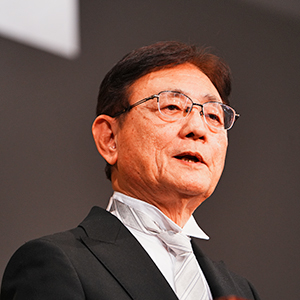
Nagahiro Minato, 27th President
Today, Kyoto University welcomes 2,383 new students enrolling in master's programs, 313 enrolling in professional degree programs, and 955 enrolling in doctoral programs. On behalf of the University's faculty and staff members, I congratulate all of you on your enrollment at Kyoto University. I also extend my warmest congratulations to your families and all those who have encouraged and supported you thus far.
Beginning today, you have all taken a new step forward in your academic pursuits by enrolling in a master's or doctoral program at Kyoto University. Kyoto University has departments spanning a diverse range of academic fields, and in addition to its 18 graduate schools, your learning will be supported by over 30 affiliated research institutes and research centers. The University also provides five Leading Graduate School Programs and three doctoral programs for the World-leading Innovative and Smart Education (WISE Program), in which students acquire the practical knowledge and technological skills needed to address issues in modern society.
So, let us consider for a moment the characteristics of a graduate school, such as those in which you are now enrolled. Graduate schools provide highly specialized educational programs designed for students who have graduated from a four-year university course and hold a bachelor's degree. Graduate schools require students to pursue a specific degree through their own program of independent research. The first graduate school to provide such a "degree-granting education program" was at Johns Hopkins University in the US in the late 19th century. At that time, Johns Hopkins had an exceptional scholarship program, making it extremely competitive, with very limited openings, and attracting only the most outstanding students. From the 20th century onward, such graduate programs spread rapidly to other universities throughout the US, and the number of degree recipients increased rapidly. As the "best and brightest" elite, those graduates have assumed leadership roles not only in academia, but also in politics, local government, industry, the media, education, and even NGOs and think tanks -- essentially every sector of society -- and they are said to have been the driving force behind the United States' remarkable development.
In contrast, while the rate of enrollment in four-year university courses in Japan has steadily increased since the end of World War II and has already exceeded 50%, the rate of enrollment in graduate schools has remained at a very low level. According to the Current Status of Education, Science, Technology and Innovation report published by the Japan International Science and Technology Exchange Center, the number of graduate school enrollees per 1,000 people in Japan in FY 2020 was 0.95, which is significantly lower than 5.44 in France, 5.33 in the UK, 3.88 in Germany, and 2.15 in the US, making Japan's figure the lowest among OECD member countries. This trend is similar for doctoral programs as well. Even taking into account the effects of a declining birthrate and aging population, Japan's low graduate school enrollment rate is evident from an international perspective, and, inevitably, that is directly reflected in the fact that the total number of degree holders in Japan is significantly lower than in other developed countries. The world has entered an era of rapid technological innovation and globalization, but the stagnation -- and even decline -- in the number of degree holders is deemed a major concern for Japan's future socioeconomic growth and international competitiveness.
Consequently, various initiatives are currently being implemented not only by universities but also by society as a whole -- including the government and the business sector -- to increase the number of people pursuing graduate studies. In addition to financial support such as scholarships, Kyoto University provides numerous educational courses and various internship opportunities designed to help students acquire transferable skills that can meet the diversifying needs of society through its Division of Graduate Studies. Furthermore, Japan's Ministry of Education, Culture, Sports, Science and Technology has recently begun to significantly expand its grant-based scholarship programs, and the business sector has established various preferential treatment systems for degree holders, while working to create an environment in which they can fully contribute. All of these recent developments reflect society's high expectations for degree holders who have received the highest level of education, and it is against this backdrop that you are beginning your new pursuit of education and research in a graduate school, as you work to earn your degree.
While the question of how academic and scientific research at universities can contribute to society is certainly important, I believe the nature of that contribution can vary greatly depending on the academic field. We often hear the terms "basic research" and "applied research", These terms first gained prominence in the US immediately after World War II, emerging from a debate over who should bear the cost of funding the academic and scientific research necessary for public policy. In 1945, Vannevar Bush, who was the president's science advisor, put forward the principle that public research funding should be used for research that contributes purely to the advancement of science -- that is, basic research -- and not for applied research conducted by companies and other entities for the purpose of product development.
Today, basic research is generally used to describe research driven by researchers' spontaneous interest and inquisitiveness, and it is often contrasted with developmental research aimed at achieving specific outcomes or clinical research aimed at treating or preventing human illnesses. However, in today's world of highly advanced science and technology, it is not easy to divide academic research by function in this way, nor does it seem particularly meaningful to do so.
Professor Jared Diamond of the University of California makes an interesting point in his book Guns, Germs, and Steel:
"In fact, many or most inventions were developed by people driven by curiosity or by a love of tinkering, in the absence of any initial demand for the product they had in mind. Once a device had been invented, the inventor then had to find an application for it. (…) Thus, invention is often the mother of necessity, rather than vice versa."
For example, even inventions that seem to have a clear purpose, such as the automobile, took a long time to reach practical application. Although Nikolaus August Otto invented the internal combustion engine in 1866, it wasn't until 1885 that Gottlieb Daimler improved upon it and developed a motorcycle, and it wasn't until 1896 that he built a truck capable of transporting goods. In other words, it took 30 years for the invention to give rise to a practical need.
One of the main challenges ahead of us is determining exactly what kind of genuine social value the advancements in AI technology, which have garnered significant attention in recent years, can actually bring about. I believe that the path by which scientific breakthroughs translate into meaningful social value is by no means a smooth, straight road; rather, it is often the result of the cumulative efforts of many researchers engaged in truly creative research.
Rather, I think what is truly important for researchers is how to maintain autonomy in their research. While the Japanese are often described as a highly conformist people, in the world of academic research, conformity is by no means a virtue. The Dutch historian Rutger Bregman shared an interesting anecdote in his book Humankind: A Hopeful History.
A professor of behavioral economics at Duke University, a prestigious institution in the US, gave a nonsensical lecture to his students explaining the field with definitions that seemed to be extremely technical and meaningful. However, the terms the professor used -- such as "dialectic enigmatic theory" and "neodeconstructive rationalism" -- and the explanations he provided were all randomly generated by a computer and completely meaningless. However, the students listened intently to his nonsensical lecture; reportedly, no one laughed, and no one showed any sign of not understanding. This is a phenomenon known in social psychology as "pluralistic ignorance". Because their friends were listening so attentively, the students assumed that if they didn't understand, the problem must lie with them. While the kind of conformity demonstrated by this experiment may not be particularly harmful, it could lead to disastrous consequences if it occurred in the realms of politics or economics.
Bregman said, "Trust often begins when someone dares to go against the flow." This likely holds true for academic research as well; breakthroughs often seem to arise from daring to question widely accepted ideas and concepts. What is necessary for independent research may be the "will to doubt" -- even if it means going against the flow. I believe that this "will to doubt" lies at the foundation of the originality and pioneering spirit that Kyoto University has long valued as part of its tradition of academic research.
Regardless of the field, academic research begins with an individual's curiosity and a desire to explore the unknown, and for those involved it is both enjoyable and challenging. That joy is, ultimately, the driving force behind academic research, and that remains unchanged despite the changing times. Having spent almost half a century in the world of academic research myself, I have faced many struggles and hardships, but looking back now, I can say that in the end, I was even able to find joy in those struggles and hardships.
In closing, I would like to offer my heartfelt congratulations and express my sincere hope that you will all thoroughly enjoy your lives as researchers in the graduate programs here at Kyoto University.
Once again, I extend my sincere congratulations to each of you.