
Nagahiro Minato, 27th President
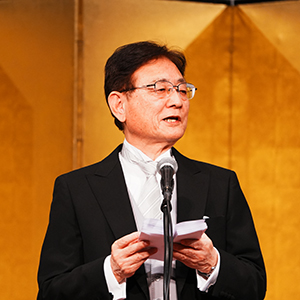
Kyoto University today welcomes 2,942 new undergraduate students. On behalf of our guests of honor, former President Juichi Yamagiwa and Dr Yasuhiro Tsujimoto, as well as the executive vice-presidents, deans, and directors in attendance, and all of our other faculty and staff, I congratulate each and every one of you on your enrollment at Kyoto University. I would like to pay tribute to the tremendous amount of effort you must have made up to this point, and also express my deepest appreciation to your families and all those who have encouraged and supported you in your efforts. I can imagine how excited you must be to be here at your university entrance ceremony, reaching a major milestone. This achievement is without doubt a testament to your own efforts, but at the same time, I want you to keep in mind that you also owe your success greatly to the strong support and encouragement you have received from your families, teachers, friends, and many other people.
Today you become students of Kyoto University. Until now, you have all worked hard with university admission as a major goal. This was surely one very important process in the course of your lives. From this point on, however, each of you will enter a new stage of life in which you set your own goals through trial and error, and continue to move forward toward them sparing no effort. Today, as you embark on this new journey, I would like to share my thoughts with you on the importance of writing in your own words.
Writing is one of the most important means by which we express ourselves. As you proceed into the academic world through your respective disciplines, you will soon realize that writing is an indispensable element in your studies. Writing is not merely a matter of conveying information; it is a process of striving to express one's emotions and thoughts with as much accuracy and clarity as possible. In other words, to write is, quite simply, to express oneself -- and doing so requires careful thought. This means taking the time to seek out the most appropriate words and expressions, and in doing so, gradually refining one's thoughts and feelings. It is difficult to write without thinking, just as it is difficult to think without writing.
In recent years, with the widespread adoption of generative AI, coherent responses to assigned tasks can be produced almost instantaneously in the form of complete texts. However, no matter how logically organized such AI-generated writing may be, it is not, of course, your own expression. Here is a passage from a collection of inspirational correspondence between Tomio Tada, an immunologist renowned as a highly adept writer, and the geneticist Keiko Yanagisawa. Tada writes: "[Scientists] should focus more on conveying the thrill they have gained from their own discoveries in a way that thrills others in the same way. If they don't, how can they expect others to appreciate their work?"
With the spread of social media, interpersonal communication is now more often conducted through written text than through direct conversation. In such communication, speed is given the highest priority, and textual information should be as short and brief as possible. As a result, instead of carefully considered words or thoughtful ways of expressing oneself, clichés, stock phrases, and even emojis are used indiscriminately. There is growing concern that this may be leading to an increasing uniformity and impoverishment of people's vocabulary and modes of expression.
The historian Timothy Snyder, currently a professor at the University of Toronto, has noted that this trend brings to mind the fictional language "Newspeak", coined by the British writer George Orwell in his 1949 dystopian novel Nineteen Eighty‑Four. In the novel, Newspeak is introduced under the totalitarian rule of Big Brother to radically simplify language and reduce the range of vocabulary, thereby narrowing and simplifying the scope of people's thinking. If a word disappears, the concept it denotes will eventually disappear as well. The loss of vocabulary and of concepts in turn leads to a decline in the quality of thought and discourse, and ultimately, it is suggested, to the erosion of people's freedom of thought and expression.
So how can you learn to write in your own words? The best approach is to read a great many well‑written texts. The immunologist Tomio Tada, whom I mentioned earlier, also writes about Dr Susumu Tonegawa, an alumnus of our university who received the 1987 Nobel Prize in Physiology or Medicine for his discovery of the genetic basis of antibody diversity. Having read Tonegawa's paper, Tada writes: "It had clarity, logic, accuracy, and a sound structure. I thought, this is how all scientific papers should be. It exuded the kind of thrill that a baseball batter surely feels upon hitting a home run."
When I was a third‑year undergraduate, I encountered a book entitled Cellular Immunology (Melbourne University Press, 1969), written by Sir Frank Macfarlane Burnet, who received the 1960 Nobel Prize in Physiology or Medicine for discovery of acquired immunological tolerance. At the time, I did not fully understand the book, finding it quite difficult, but the opening passage of its final chapter has remained vivid in my memory ever since. He writes: "In the last decade there has come into being, without either flourish of trumpets or serious controversy, a general current of belief in what I have come to call 'immunological surveillance.'"
The intellectual journey that led to this groundbreaking concept came across vividly, infused with Sir Burnet's restrained excitement and deep conviction. Looking back, this book marked my first encounter with cancer immunology, and it ultimately shaped my life's work in research. Today, if one asks generative AI about topics such as "antibody gene rearrangement" or "cancer immunological surveillance", it will offer extremely concise and accurate explanations almost instantaneously. However, writing produced by generative AI can never convey the vivid excitement or profound sense of wonder that accompanies the discovery of these remarkable facts and extraordinary concepts.
In 2024, we began inviting alumni to deliver addresses to the incoming students on the occasion of the undergraduate entrance ceremony. In the first year of this initiative we had Ms Megumi Aoyama, a graduate of the Kyoto University Faculty of Economics. After completing a graduate program in the United States, she went on to work as a senior project officer with the Office of the United Nations High Commissioner for Refugees (UNHCR), where she has been providing support for refugees in conflict zones around the world, including Ukraine. Last year, we welcomed Ms Mai Komuro, an architect who graduated from the Undergraduate School of Architecture of the Faculty of Engineering. After studying at a university in Switzerland and gaining experience at prominent architectural firms overseas, she established her own architectural design studios in Hong Kong and Tokyo. Ms Komuro works actively on the global stage.
This year, we are honored to welcome Dr Yasuhiro Tsujimoto, a graduate of the Kyoto University Faculty of Agriculture, who currently serves as a project leader at the Japan International Research Center for Agricultural Sciences, a national research and development agency. During his time in graduate school, Dr Tsujimoto visited Madagascar, where he directly experienced the reality of severe poverty and famine confronting Africa. Motivated by a strong desire to contribute, even in a small way, to solving the food and environmental challenges facing contemporary Africa, he has continued to conduct field-based research on the front line in the region. He will share his experience with you later in this ceremony.
There is one thing that all of these seniors of yours have in common. Guided by their own interests, ideals, and sense of mission, they have quite literally traveled across the globe, steadily building up experience and achievements along the way.
As for myself, inspired by my encounter as a student with the book by Sir Frank Burnet that I mentioned earlier, I traveled to the United States after graduation and finally, in a laboratory in New York, began the research I had long hoped to pursue on cancer and immunity. For a full three years in my late twenties, I spent my research life working alongside young researchers and graduate students from across the United States and from around the world. I believe that the experience I gained during that period played a decisive role in shaping the course of my subsequent life. Had I not had the opportunity to live abroad at a young age, my life would have turned out very differently. Self‑discovery is often sparked by new encounters, and living in another country in particular may lead you to discover unexpected new aspects of yourselves. Such experiences may make your lives much richer and greater.
Kyoto University strongly encourages you to spend time abroad during your years of study here, and offers a variety of programs, along with advice and financial support to help you do so. Even a short period of living overseas and interacting with peers from different countries will surely help you discover aspects of yourselves you may not yet be aware of.
In your lives as Kyoto University students, I hope that you will experience as many new encounters as possible, discover new sides of yourselves you had never imagined, and find goals to pursue in the years ahead.
Once again, I offer my sincere congratulations to each and every one of you.