

Nagahiro Minato, 27th President
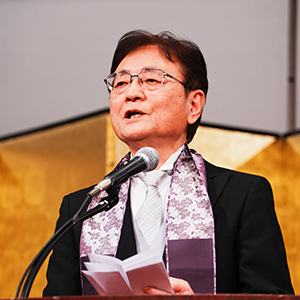
Today, Kyoto University is proud to award 2,144 master's degrees, 156 professional master's degrees, 140 juris doctor degrees, and 616 doctoral degrees. Of these graduates, 508 are international students. Let me begin by offering my sincere congratulations to all of you on your accomplishments.
With today's ceremony, Kyoto University will have awarded a cumulative total of 97,295 master's degrees, 3,025 professional master's degrees, 3,195 juris doctor degrees, and 50,334 doctoral degrees. On behalf of the executive vice-presidents, deans and directors, and program coordinators here today, as well as all of the other Kyoto University faculty and staff, I would like to extend my congratulations to each and every one of you on receiving your degree.
Having completed your graduate school programs, each of you is now advancing to an even higher level of research or stepping out into wider society as the holder of a master's or doctoral degree from Kyoto University. Do you know how many degree holders like you there are in Japan? According to the Japanese Science and Technology Indicators 2025, published by the National Institute of Science and Technology Policy of Japan's Ministry of Education, Culture, Sports, Science and Technology (MEXT), in fiscal year 2022, master's degrees were awarded to 602 people per million population, which is an exceptionally low proportion compared to the 6,057 per million in the UK, 2,649 in the US, and 2,430 in Germany. It is lower even than China's figure of 655. When it comes to doctoral degrees, the number awarded per million population in Japan was just 123, far lower than in countries such as the UK (355), South Korea (342), Germany (314), and the US (286).
Needless to say, this is largely because the growth rate of graduate school enrollment in Japan has been markedly lower than that of other advanced OECD countries. This is a serious cause for concern in Japan, which has long proclaimed itself a "science and technology-driven country". Since the 1990s, MEXT has therefore pursued policies to bolster graduate education at national universities. These policies produced a rapid rise in the number of graduate students until the early 2000s. Since around 2010, however, the growth has stalled and a downward trend has even been observed, especially in doctoral programs.
Today's graduate school system originated in the latter half of the nineteenth century in the US, beginning with Johns Hopkins University, which was modeled on German research universities. It was conceived as an advanced, highly specialized educational framework for students who had completed a liberal arts undergraduate education, incorporating as a fundamental requirement the awarding of degrees based on individualized research programs. Over the course of the twentieth century, this graduate school model spread rapidly throughout the US. Degree holders went on to play leading roles in the country's development through the twentieth century as the nation's "best and brightest" -- not only in academia but also in politics, the government, local administration, industry, the mass media, education, and even in NGOs and think tanks.
In Japan, however, at least until relatively recently, graduate degree holders did not come to play active roles across such a wide range of social sectors as they have in the US. For example, according to materials from the Ministry of Economy, Trade and Industry, nearly 70 percent of corporate executives and CEOs in the US hold graduate degrees, whereas in Japan the figure is said to be less than 20 percent. Among advanced countries, one of the most significant reasons that graduate school enrollment -- and consequently the number of degree holders -- has stagnated in Japan is the insufficient development of career paths outside academia for those who earn advanced degrees. This situation appears to stem from factors on both the university side and the societal side. Recently, however, rapid and notable new developments have begun to emerge in response to this issue.
Looking first at universities themselves, we see that historically, graduate education in Japan has had a strong orientation toward academic research. The career paths envisioned for doctoral degree holders in particular have centered primarily on positions as university faculty or researchers at research institutions. In Europe and North America, especially in the natural sciences, it is common for those seeking to become independent researchers to spend several years as postdoctoral fellows, or "postdocs", following the completion of their doctoral degrees, before applying for university faculty or academic research positions.
The postdoc period serves as an important process of acquiring the practical skills required of an independent researcher, and the associated employment costs are typically treated as researchers' salaries and covered by research funding. In Japan, however, for many years public research funds could not be used to cover the employment costs of postdoctoral researchers, and as a result, this system failed to take root. Consequently, although degree research conducted by graduate students has formed the core of research activity at Japanese universities, career paths from degree completion to independent research positions have often remained unclear and unstable. In recent years, however, employment costs for postdoctoral researchers have finally begun to be recognized within substantial public research funding programs, and the number of such positions has been increasing. At Kyoto University as well, in our efforts to become accredited for the Japanese government's Universities for International Research Excellence program, we plan to establish positions for postdocs and other early-career researchers, and formalize a clear, structured pathway from doctoral training to independent research careers.
Another major change concerns how society responds to degree holders. Japan, which once astonished the world with its postwar recovery and growth -- often described as the "miracle of the East" -- has seen its growth slow markedly since the end of the twentieth century, amid rapid technological innovation and accelerating globalization. Under these circumstances, the roles and purposes of universities have become a matter of heightened concern across both the public and private sectors. This reflects, I believe, a growing sense of expectation being placed on universities, as symbols of higher knowledge and international engagement, to help address the current impasse.
This heightened expectation is evident, for example, in recent policy proposals such as MEXT's "Get a PhD -- Doctoral Human Resources Action Plan", issued in fiscal year 2024, and the proposal titled "Toward the Realization of a Society in which Doctoral Talent Thrives: Vision and Concrete Initiatives", released by the Industry-Academia Council on Doctoral Human Resources, which brings together representatives from national, public, and private universities and the Japan Business Federation. One of the central expectations expressed in these proposals is the active contribution to society of highly educated graduate degree holders.
In other words, there is a growing momentum across government and industry alike to create environments in which graduate degree holders can fully apply and demonstrate the abilities they acquired in graduate school across diverse and wide-ranging sectors of society. In response, through the Kyoto University Division of Graduate Studies, we have established basic graduate courses to meet the growing demand for advanced talent development driven by increasing societal complexity, diversification, and globalization. Many graduate students are now taking advantage of these courses.
In recent years, amid the flourishing of venture companies in the US and elsewhere, startup and venture activities originating from universities have rapidly expanded in Japan, aiming to bring research outcomes directly into practical use in society. At Kyoto University, we have also put in place support systems at various levels to encourage such activities by researchers and graduate students. These efforts have led to the emergence of more than 400 university‑originated startups and ventures to date. Many of these are so‑called impact startups that are strongly oriented toward the resolution of issues confronting society, such as energy, the environment, food, and health. While the term "venture" generally refers to entrepreneurship, university‑originated startups in particular are grounded in a strong determination to bring about transformation in society through research findings. In a sense, this may be seen as an extension of the frontier spirit that we as researchers have traditionally valued. Although each startup's endeavors may appear small in isolation, the diversity and originality of these initiatives hold the potential, once they interact and converge, to generate innovations that exceed expectations and bring about dramatic changes in people's lives and in society as a whole.
As you know, a doctoral degree is referred to as a PhD, which is an abbreviation of the Latin Philosophiae Doctor. This term originally denoted a degree from the faculty of philosophy, one of the four traditional university faculties -- the others being in the practical disciplines of theology, law, and medicine. Over time, PhD came to refer to doctoral degrees in all fields devoted to the pursuit of truth, regardless of discipline. This is "the protean PhD" as described in the biography of Daniel Gilman, the first president of Johns Hopkins University mentioned earlier. It is precisely in times of profound change, such as the present, that individuals like yourselves -- who have not only acquired scientific knowledge but, more importantly, learned how to pursue science itself and refined your powers of reason through sustained intellectual training -- are expected to demonstrate truly protean capacities and contribute across a wide range of societal domains.
In the UK, which has the highest number of graduate degree holders per million population, graduate education places the utmost emphasis on using the process of research toward a degree to cultivate universal skills of identifying and solving problems. These foundational skills can be applied even when the nature of the problem changes and are therefore known as transferable skills. They are regarded as essential capabilities that enable graduate degree holders to respond effectively to the diverse challenges they encounter in the real world. Now that universities and society in Japan are finally beginning to create conditions in which graduate degree holders can fully realize their potential, the question of where and how you, as degree holders, will contribute is becoming a matter of growing interest across society.
A few years ago, I had the opportunity to give sworn testimony in a courtroom in the US, as a witness in an international patent trial involving medical intellectual property. On that occasion, I was struck by the exceptionally high level of expertise and understanding of the life sciences demonstrated by the American attorneys in charge of the case. When I asked why legal professionals possessed such deep knowledge of the life sciences, they explained that they had studied the field as undergraduates and gone on to earn graduate degrees. One of them had even worked as a postdoctoral researcher before entering law school and ultimately becoming an attorney specializing in science-related cases. One comment I heard on that occasion particularly struck me: "Life is long, and in the US it is by no means unusual to make major changes in one's career path midway through one's life."
I would like to conclude my remarks by expressing the heartfelt hope that, as you step out into a new world, you will deploy the strengths you have cultivated thus far to the fullest, and go on to make significant contributions across a wide range of domains in society.
Once again, let me offer my sincere congratulations to each and every one of you.