

Nagahiro Minato, 27th President
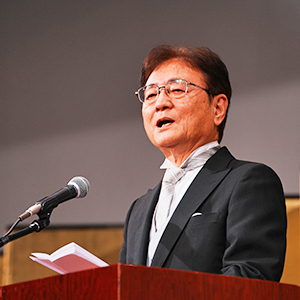
Let me begin by congratulating the 2,765 undergraduate students who are graduating from Kyoto University today. On behalf of our executive vice-presidents, deans and directors, and all of the University's faculty, staff, and students, I extend our heartfelt congratulations to each one of you. Your family members, relatives, and others who have provided you with support and encouragement throughout your academic journey must be very proud of you. I would also like to express our deepest gratitude and congratulations to all those people. The students gathered here today are now among the 231,573 who have been awarded undergraduate degrees in the 126 years since Kyoto Imperial University held its first graduation ceremony in 1900.
Most of you graduating today enrolled at Kyoto University four years ago, in April 2022. Looking back, it was in February of that year that we were confronted with the shocking news of Russia's full-scale military invasion of Ukraine. As the conflict continued to expand, many Ukrainian citizens were forced to flee both within the country and abroad. We also learned that university students there, faced with campus closures, were searching for ways to continue their studies in safer countries overseas. We promptly contacted Taras Shevchenko National University of Kyiv and the National Technical University of Ukraine, with which our university has academic exchange agreements. We were told that the situation on the ground was extremely dangerous, and that they would be grateful if we could host as many students as possible at Kyoto University. We immediately began preparing to receive them, and two months later, on 28 April, we launched the Ukraine Crisis Relief Fund and began soliciting donations. By the fall of that year, we were able to welcome an initial group of 15 students. Even now, I clearly remember the complex expressions on the faces of those students who had made the arduous journey to Japan from Kyiv via various routes -- faces reflecting a mixture of anxiety and relief.
More than four full years have already passed since then. Regrettably, the fighting has yet to cease. Nonetheless, thanks to the generous support of so many donors, we have continued to host students from Kyiv each year, and the cumulative total has now reached approximately 70. Some of you may have had opportunities to meet and speak with those students -- at international exchange events, or perhaps in your classes or club activities. I cannot help but sincerely hope and pray that peace will return to their homeland as soon as possible, so that they may safely return to their country and resume their studies with peace of mind.
We have long spoken of living in an information society, and our communication today has become almost instantaneous through social media. At the same time, some of you who experienced the COVID-19 pandemic before entering university -- when classes and communication with friends had to rely entirely on online platforms -- may have gained a new appreciation of the importance of direct, face-to-face communication after coming to the University. In direct verbal interaction, people share the same physical space and time, and unconsciously perceive information from their surroundings through all five senses. Communication takes place as these sensory impressions are integrated. This, I believe, underlies distinctly human communication, which includes sensing the atmosphere and subtle nuances of a situation and being mindful of others' feelings.
What do we mean by "human"? The Dutch historian Rutger Bregman, in his book Humankind: A Hopeful History (Bloomsbury, 2021), discusses research that offers an intriguing perspective on dialogical communication as a defining characteristic of Homo sapiens. For example, a German research team conducted a series of comparative tests involving human infants and adult orangutans and chimpanzees, examining their spatial cognition, numerical ability, and understanding of causality. Humans were tested as infants in order to minimize the effects of learning acquired after birth. The results showed that all three groups achieved similarly high scores, indicating no significant differences in working memory or information-processing capacity. Comparable findings have been confirmed by many other studies. However, when the researchers added tests designed to measure social learning ability, a striking difference emerged. While most of the apes scored close to zero, most of the human infants achieved perfect scores. "Social learning" here refers to the ability to learn from others. These findings strongly suggest that one of the decisive differences separating humans from other apes lies in our capacity for dialogical communication with others -- in other words, our sociality.
Interestingly, the importance of dialogical communication in humans' social life also appears to be reflected in our physical characteristics. One such feature is blushing. Humans, to varying degrees, blush out of a sense of embarrassment or shame. We are the only animal species that does so. Charles Darwin, the pioneer of evolutionary theory, described "blushing" in The Expression of the Emotions in Man and Animals (originally published in 1872) as "the most peculiar and the most human of all expressions". Turning red in the face is a social expression of emotion that indicates our concern about how we are perceived by others, and it can serve as a foundation for the relationships of trust, cooperation, and other social interactions with those around us.
Another distinctive feature is the "white of the eye". In human eyes, the round pupil and iris -- known in Japanese as the "black of the eye" -- are surrounded by a region covered by white sclera, commonly called the "white of the eye". In humans, this white area is relatively large, so even subtle movements of the pupil clearly reflect the line of sight. In other words, people facing one another can easily track the direction of the other's gaze through small movements of the eyes. It is said that there are more than 200 species of primates on earth, but in all nonhuman species the scleral area is small and often colored ochre or another hue, making eye movements far more difficult for others to discern. There is an old saying that "the eyes speak as much as the mouth", and it may be that the uniquely human capacity for subtle eye movements has evolved so that, in dialogical communication with others, we can convey unspoken thoughts and delicate emotions.
Related to this point, the historian Timothy Snyder, currently a professor at the University of Toronto, offers an intriguing piece of advice as one of his lessons for the internet age: "Make eye contact and small talk." While a computer does not look back at you, it's difficult to ignore the gaze of another human being. As you prepare to step out into wider society, there will surely be times when you need to engage in direct discussions with people whose opinions and standpoints differ from your own. The experience you have had here at Kyoto University in making eye contact and small talk should have served as valuable preparation for those moments.
In the address I delivered at your entrance ceremony four years ago, I spoke of how you were about to set out on a full‑fledged journey toward "self‑discovery" and "self‑expression", and of how self‑discovery is often brought about through new "encounters". Over the course of your student life, you have no doubt experienced many such encounters with new friends and senior students, with books that captivated you, and with events that left a lasting impression. I wonder, then, whether these encounters have also led you to new discoveries about yourselves.
In the US, university graduation ceremonies are often called "commencements". While many US universities do not hold an entrance ceremony, they celebrate graduation on a grand scale. Originally meaning "beginning" or "start", the term "commencement" is used for graduation precisely because it is, in essence, a ceremony marking the beginning of one's life's journey. Your own journey of self‑discovery will continue into the future. What matters is that you keep the doorway to new encounters as wide open as possible, and that you embrace those encounters without hesitation. It is through the new self‑discoveries born of such experiences that your latent qualities and abilities will be fully drawn out, leading you to genuine self‑realization. As children of the twenty‑first century, you have been given what is often called the "100‑year life": a life that affords you ample time to repeat this process of self‑discovery and self‑realization many times over, without rushing.
Today, as you complete your undergraduate degrees at Kyoto University, you are about to embark on a new journey -- some of you toward more advanced research, others into the world beyond the University. Each year at the graduation ceremony, I share with our graduates a thought inspired by Lucy Maud Montgomery's novel Anne of Green Gables. In the chapter entitled "The Bend in the Road" -- which depicts the period when the protagonist Anne Shirley, much like yourselves today, finishes her schooling and begins her work as an elementary school teacher -- she expresses her excitement about her future using the analogy of a bend in a road and what lies beyond it.
A straight road that offers a clear view far into the distance may feel safe and reassuring, but a road with bends may bring you unexpected encounters along the way. Inspired by Anne Shirley's boundless curiosity about life and nature, and her extremely bright optimism, I hope that each of you will experience many wonderful encounters in the years to come. What we call "serendipity" -- a chance discovery that seems almost accidental -- is something that comes only to those whose hearts are prepared to receive it.
I would like to conclude my address with a heartfelt wish that you, as responsible and engaged citizens, will boldly forge your worlds as you explore the many paths that lie before you.
Once again, please allow me to offer my sincere congratulations to each and every one of you.