

Nagahiro Minato, 27th President
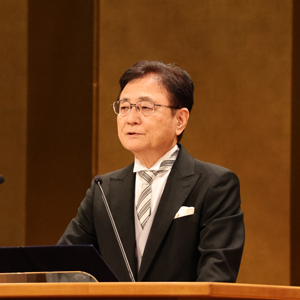
Today, Kyoto University welcomes 86 new students enrolling in master's programs, 133 enrolling in doctoral programs, and 8 enrolling in professional degree programs. On behalf of the University's faculty and staff members, I congratulate all of you on your enrollment at Kyoto University. I also extend my warmest congratulations to your families and all those who have encouraged and supported you thus far. In particular, I would like to extend a heartfelt welcome to the many international students who have enrolled in one of Kyoto University's graduate schools.
You have all completed your undergraduate studies and taken a new step towards pursuing advanced academic research in graduate school. Kyoto University comprises 18 graduate schools in a diverse range of academic fields, as well as over 30 affiliated research institutes and centers to support your studies. Furthermore, the University provides five Leading Graduate School Programs and three doctoral programs for the World-leading Innovative and Smart Education (WISE) Program, which equip students with the practical knowledge and skills required to address the challenges faced by modern society.
Let us consider for a moment the characteristics of a graduate school, such as those in which you are now enrolled. The report titled Graduate School Education in a New Age, produced by the Central Council for Education of Japan's Ministry of Education, Culture, Sports, Science and Technology defines graduate schools as follows: "Graduate schools in Japan are places of education that provide students with a systematic education, based on defined educational objectives and through programs of specified length and curricula, and that award those who have completed such programs with specified academic degrees." This concept of a "curriculum that awards degrees" is shared internationally, meaning that graduate schools are educational programs that grant master's and doctoral degrees.
So, what are the qualities and abilities that are expected of degree holders? Kyoto University's diploma policy states the following criteria for evaluation:
"In master's degree programs, students should acquire broad and deep knowledge, research skills in specialized fields, and excellent abilities to engage in professions that require a high degree of expertise."
"In doctoral programs, students should acquire the abilities and academic knowledge required to work independently as researchers and engage in highly specialized work."
Upon embarking on such a graduate school course, each of you will find your own research topic, create a plan to address that topic, and acquire the necessary skills and knowledge as you undertake various forms of research by yourself. Ultimately, you will also be responsible for preparing your doctoral dissertation by building on your discussions with many fellow students, seniors, and academic advisors. In graduate schools, senior students and faculty serve as mentors, whom you can consult about anything, not just research and studies. The word "mentor" comes from the wise man Mentor, who appears in Homer's ancient Greek epic poem, The Odyssey. Because Mentor served as a wise advisor to Prince Odysseus, the term "mentoring" became widely used to mean aiding the independent growth of juniors through insights and advice gained through dialogue.
As one of your mentors myself, I would like to share some important points about the mindset that you will need as you embark on your graduate degree research. First and foremost, you need to have a strong motivation and a deep commitment to the research topic you are about to undertake. This could stem from an inexhaustible curiosity and desire to explore nature and life phenomena, or it could arise from an interest in complex social phenomena and diverse human activities. In the course of your research, you will inevitably encounter various difficulties and obstacles, but what will give you the strength to overcome them will ultimately be your own intrinsic motivation and the depth of your personal commitment to your research topic. As long as you constantly remember and maintain your motivation for the research topic you are about to undertake, your research will undoubtedly yield results.
Secondly, when conducting your research, I would like you to strive as much as possible to take a broad spatial perspective that connects society and the wider world, and encompass long temporal scope spanning the past, present, and future. No matter what academic field you pursue, it is impossible for your research to be completely unrelated to society and the times. It is certainly not a waste of time to consider how the research topic you are about to tackle might relate to various societal issues. Our graduate schools provide interdisciplinary research programs in which students and researchers from diverse fields collaborate across the borders of individual graduate schools to tackle larger research problems. Participating in such interdisciplinary programs while pursuing your own research will greatly broaden your perspective and help you reaffirm the significance of your research.
Thirdly, it is important to be aware of the potential to translate the achievements of your graduate degree research into tangible social value. Recently, you may have often heard the term "impact startup". An impact startup differs from general business venture, whose main purpose is to generate profit. Instead, it is founded on a clear desire to actively contribute to society by applying the results of academic research activities. This type of spirit is also referred to as "entrepreneurship", and realizing it often requires techniques and initiative different from those required for academic research itself. Our graduate schools provide courses designed to cultivate entrepreneurship, which may eventually guide your academic research toward new horizons.
We are living in the age of artificial intelligence (AI), and I have no doubt that AI will play a major role in your doctoral research, regardless of your field. Last year, Dr John J Hopfield of Princeton University and Dr Geoffrey E Hinton of the University of Toronto were awarded the Nobel Prize in Physics for "foundational discoveries and inventions that enable machine learning with artificial neural networks". It was met with great surprise that the Physics Prize, which had traditionally been awarded for research into natural phenomena, was instead awarded for research into machine learning algorithms. Reproducing higher-level human brain functions, such as cognition, thought, and language, using machines has long been a scientific challenge, and applications based on that approach, such as deep learning and generative AI using large-scale language models, are now being implemented in society. Machine learning using artificial neural networks is said to be based on pattern recognition and analogy-based inference. While human cognition and thought were traditionally thought to be based on clear logic and deductive reasoning based on that logic, Dr Hinton stated in a lecture at his alma mater, the University of Toronto, that we humans are not so much "reasoning machines", but rather "great big analogy machines".
While it's debatable whether humans are 100% "analogy machines", it is undeniable that AI can now make decisions far more efficiently than humans when it comes to pattern recognition and optimization through analogy -- areas in which AI excels. Examples of this include AI often outperforming humans in Go games, bar exams, and national medical exams. However, we must remember that it is ultimately humans who master and utilize such AI. Recently, I attended a lecture in Switzerland by Dr Alessandro Curioni, a computer security expert and director of the IBM Research Lab. He stated, "AI is ultimately a tool -- an incredibly intelligent tool." The key question is how accurately and skillfully we can use AI as a tool, based on a thorough understanding of its unique cognitive characteristics. One social concern surrounding AI is the fear that its rapid proliferation could eliminate a significant number of jobs. Ironically, a current issue in the United States is the serious shortage of jobs for computer program students, who have been trained in large numbers as IT professionals. This is because ordinary computer programming is now done by AI. I was struck by what a veteran software engineer said in an interview with CNN: "AI will not replace you as an engineer. An engineer with AI will replace you as an engineer."
Here too, the issue seems to be how to use AI wisely. One of the crucial differences between humans and AI is that humans have a very long history of life built into their genomic information, dating back to the days before written language. I think that the aspects of humans that have been cultivated as "reasoning machines" and "ethics machines" can naturally serve to correct or put the brakes on the judgments and decision-making of AI, which functions as an "analogy machine".
Finally, please remember that while the content of your degree research is important, the overall process you experience and master during that research is also extremely important. You will gain what is known in Western countries as "transferable skills". These include "problem-solving skills" for identifying problems and working to solve them, "personal skills" for organizing one's own initiative to tackle challenges, and "interpersonal skills" for building teams and relationships to achieve tangible results. In today's increasingly diverse and complex society, there is no doubt that degree holders equipped with transferable skills will be needed more than ever to tackle the new challenges we face in the real world. I hope you will keep this in mind as you embark on your degree research at Kyoto University, and that you will enjoy the journey to the fullest. I would like to conclude my congratulations with that heartfelt wish.
Once again, I extend my sincere congratulations to each of you.